Canberra home furniture built for families and spontaneous dance parties.
Buying Furniture in Canberra: A Guide to Finding the Perfect Pieces
Furnishing a home is one of the most exciting-and sometimes overwhelming-tasks for anyone settling into a new space. Whether you're a first-time renter, a growing family, or someone looking to refresh their living environment, Canberra offers a vibrant and diverse furniture scene that caters to every taste, budget, and lifestyle. From sleek contemporary designs to classic pieces with a timeless appeal, the city's furniture stores make it easy to find exactly what you need to create a comfortable and stylish home.
One of the first things you'll notice when searching to buy furniture in Canberra is the sheer variety of options available. The city is home to a mix of large warehouse stores, boutique showrooms, and online retailers, each offering something unique. Stores like Monster Furniture and Focus on Furniture in Fyshwick are popular destinations for those seeking affordable, high-quality pieces under one roof. These warehouses are known for their extensive selections, from sofas and dining sets to bedroom and occasional furniture, making it possible to furnish an entire home in a single visit. The convenience of ample parking and spacious showrooms adds to the appeal, allowing shoppers to browse at their leisure and get a real feel for the products before making a decision.
For those who value style and sophistication, Marco Furniture stands out as a top-rated choice.
Modern beds where Canberra mornings start reluctantly.
Canberra Dining Tables
Canberra Homewares Store
Furniture decor that keeps Canberra homes fresh and fun.
Modern beds where Canberra mornings start reluctantly. With a reputation for contemporary designs and premium finishes, Marco Furniture attracts customers who are looking for something a little more upscale. Their online platform makes it easy to shop from anywhere, and their commitment to fast delivery ensures that your new furniture arrives quickly and in perfect condition. Whether you're after a statement lounge, a minimalist dining table, or a cozy bedroom set, Marco Furniture offers a curated collection that blends functionality with elegance.
Another option for bargain hunters is Homemakers Hub, Canberra's largest clearance furniture store. Canberra Furniture Store . With discounts of up to 70% off all year round, Homemakers Hub is ideal for those who want to save money without sacrificing quality. The store's ever-changing inventory means there's always something new to discover, and the guaranteed lowest prices make it a favorite among savvy shoppers. For those who enjoy the thrill of a weekend sale, Warehouse Furniture Clearance also hosts periodic events in Canberra, offering brand-new furniture at significantly reduced prices. These events are a great way to score stylish pieces for less, especially if you're furnishing a new home or updating your decor on a budget.
Beyond the practical aspects of buying furniture, Canberra's stores also prioritize customer experience. Many offer helpful service teams who can guide you through the selection process, answer questions about materials and care, and even assist with delivery and assembly. This personalized touch can make all the difference, especially for those who are unsure about what will work best in their space. Additionally, the city's central location and well-connected transport links mean that shopping for furniture is convenient for residents across the region.
Ultimately, buying furniture in Canberra is about more than just finding functional pieces-it's about creating a home that reflects your personality and meets your needs.
Furniture Stores Tuggeranong
Canberra home furniture built for families and spontaneous dance parties.
Modern beds where Canberra mornings start reluctantly.
Furniture Stores Tuggeranong
With so many options to choose from, you're sure to find something that fits your style, budget, and lifestyle. Whether you prefer the convenience of a warehouse store, the elegance of a boutique showroom, or the savings of a clearance sale, Canberra's furniture scene has something for everyone. So take your time, explore your options, and enjoy the process of transforming your space into a place you love to call home.
This article's lead sectioncontains information that is not included elsewhere in the article. If this information is appropriate for the lead, it should also be included in the article's body. Relevant discussion may be found on the talk page.(October 2022) (Learn how and when to remove this message)
Modern furniture refers to furniture produced from the late 19th century through the present that is influenced by modernism. Post-World War II ideals of cutting excess, commodification, and practicality of materials in design heavily influenced the aesthetic of the furniture. It was a tremendous departure from all furniture design that had gone before it. There was an opposition to the decorative arts, which included Art Nouveau, Neoclassical, and Victorian styles. Dark or gilded carved wood and richly patterned fabrics gave way to the glittering simplicity and geometry of polished metal. The forms of furniture evolved from visually heavy to visually light. This shift from decorative to minimalist principles of design can be attributed to the introduction of new technology, changes in philosophy, and the influences of the principles of architecture. As Philip Johnson, the founder of the Department of Architecture and Design at the Museum of Modern Art articulates:[1]
"Today industrial design is functionally motivated and follows the same principles as modern architecture: machine-like simplicity, smoothness of surface, avoidance of ornament ... It is perhaps the most fundamental contrast between the two periods of design that in 1900 the Decorative Arts possessed ..."
With the machine aesthetic, modern furniture easily came to promote factory modules, which emphasized the time-managing, efficient ideals of the period. Modernist design was able to strip down decorative elements and focus on the design of the object in order to save time, money, material, and labour. The goal of modern design was to capture timeless beauty in spare precision.[2]
Prior to the modernist design movement, there was an emphasis on furniture as an ornament. The length of time a piece took to create was often a measure of its value and desirability. The origins of modernist design can be traced back to the Industrial Revolution and the birth of mechanized production. With new resources and advancements, a new philosophy emerged, one that shifted the emphasis of objects being created for decorative purposes to being designs that promote functionality, accessibility, and production.[3]
The idea of accessible, mass-produced design that is affordable to anyone was not only applied to industrial mechanics, but also to the aesthetics of architecture and furniture. This philosophy of practicality came to be called Functionalism. It became a popular "catchword" and played a large role in theories of modern design. Functionalism rejected the imitation of stylistic and historical forms and sought an establishment of functionality in a piece. Functionalist designers would consider the interaction of the design with its user and how many of the features, such as shape, colour, and size, would conform to the human posture.[4] Western design generally, whether architectural or design of furniture, had for millennia sought to convey an idea of lineage, a connection with tradition and history. However, the modern movement sought newness, originality, technical innovation, and ultimately the message that it conveyed spoke of the present and the future, rather than of what had gone before it.[2]
The modernist design seems to have evolved out of a combination of influences: technically innovative materials and new manufacturing methods. Following the Second Industrial Revolution, new philosophies and artists emerged from the De Stijl movement in the Netherlands, the Deutscher Werkbund and the Bauhaus school, both located in Germany.
The De Stijl (The Style) movement, was founded in 1917 by Theo Van Doesburg in Amsterdam. The movement was based on the principles of promoting abstraction and universality by reducing excessive elements down to the essentials of form and colour. Dutch design generally has shown a preference for simple materials and construction, but De Stijl artists, architects, and designers strove to combine these elements to create a new visual culture. Characteristics of furniture from this movement include simplified geometry of vertical and horizontal compositions and pure primary colours and black and white. It was the rejection of the decorative excesses from Art Nouveau and promoted logicality through construction and function. Influential artists from this movement include Gerrit Rietveld, Piet Mondrian, and Mies van der Rohe, who continued to evolve the ideas of modernist design.[5][6]: 33–183 
Founded in 1907 in Munich, Germany, the Deutscher Werkbund was an organization of artists, designers, and manufacturers that pushed to create a cultural utopia achieved through a design and new ideas in the early twentieth century. They shared the Modern thought of "form follows function" as well as the "ethnically pure" design principles such as quality, material honestly, functionality, and sustainability. The DWB played a key role in advocating these to other German artists and designers, which inspired the development of many Modern design institutions. Among the most notable architects and designers from the DWB are: Hermann Muthesius, Peter Behrens, and Ludwig Mies van der Rohe.[7]
The Bauhaus school, founded in 1919 in Weimar, Germany, by architect Walter Gropius, was an art school that combined all aspects of art. It eventually was forced to move to Dessau, Germany, in 1925 due to political tensions, then Berlin, in 1932 until the doors of the school were closed from the pressure of the Nazi regime. With the change of location came a change of direction in the institution. The Bauhaus adopted an emphasis on production in Dessau, but maintained its intellectual concerns in design.[8] Throughout the years, the goal of the institution was to combine intellectual, practical, commercial, and aesthetic concerns through art and technology. The Bauhaus promoted the unity of all areas of art and design: from typography to tableware, clothing, performance, furniture, art, and architecture. Prominent artists and designers from the Bauhaus include: Marcel Breuer, Marianne Brandt, Hannes Meyer (who was Gropius's successor, only to be replaced by Mies van der Rohe).[6]: 38–138 [9]
An aesthetic preference for the baroque and the complex was challenged not only by new materials and the courage and creativity of a few Europeans, but also by the growing access to African and Asian design. In particular the influence of Japanese design is legend: in the last years of the 19th century the Edo period in Japan, Japanese isolationist policy began to soften, and trade with the west began in earnest. The artifacts that emerged were striking in their simplicity, their use of solid planes of color without ornament, and contrasting use of pattern. A tremendous fashion for all things Japanese – Japonism – swept Europe. Some say that the western Art Nouveau movement emerged from this influence directly. Designers such as Charles Rennie MacIntosh and Eileen Gray are known for both their modern and Art Deco work, and they and others like Frank Lloyd Wright are notable for a certain elegant blending of the two styles.
The use of new materials, such as steel in its many forms; glass, used by Walter Gropius; molded plywood, such as that used by Charles and Ray Eames; and of course plastics, were formative in the creation of these new designs. They would have been considered pioneering, even shocking in contrast to what came before. This interest in new and innovative materials and methods – produced a certain blending of the disciplines of technology and art. And this became a working philosophy among the members of the Deutscher Werkbund. The Werkbund was a government-sponsored organization to promote German art and design around the world. Many of those involved with it including Mies van der Rohe, Lilly Reich and others, were later involved in the Bauhaus School, and so it is not surprising perhaps that the Bauhaus School took on the mantle of this philosophy. They evolved a particular interest in using these new materials in such a way that they might be mass-produced and therefore make good design more accessible to the masses.
The first versions of Gerrit Rietveld's Red-Blue Armchair were created around 1917. However, they were originally stained black – the colour was eventually added to give characteristics of De Stijl in 1923. Rietveld's intent was to design a piece of furniture that could be cheaply mass-produced. He uses standard beechwood laths and pine planks that intersect and are fixed by wooden pegs. The functions of construction, the seat, the back and armrests are explicitly separated from one another visually. In fact, Rietveld saw the chair as the skeleton of an overstuffed armchair with all the excessive components removed. [6]: 32–183 
This modernist creation enjoyed enduring fame in the post-war period, seeing reproduction numbers upwards of four digits across two continents.[10] The Wassily Chair, also known as the Model B3 chair, was designed by Marcel Breuer in 1925–26 while he was the head of the cabinet-making workshop at the Bauhaus, in Dessau, Germany.
This piece is particularly influential because it introduces a simple, yet elegant and light-weight industrial material to be used in structures within the domestic space: chrome plated tubular steel. The design of the chair is revolutionary [citation needed] with its use of symmetrical, geometric planes framed by the tubular steel. Breuer uses simple straps on canvas for the seat, back and armrests to support the seated figure. The concept of the use of tubular steel, a never before seen the material in the domestic space was inspired by the handles of Breuer's bicycle. He reasoned that if such a material was light-weight yet strong enough to support the body in motion, it is likely to be able to support the body at rest. He applies uncomplicated essentials (the canvas strips) to create a functional aesthetic as well. Nonetheless, the Model B3 Chair (dubbed the Wassily Chair by the manufacturing company, Gavina after learning of the anecdote involving the painter Wassily Kandinsky) inspired many artists and designers to include the use of chrome plated steel, including Le Corbusier, who includes it as a structure for his Chaise Longue. [citation needed]
Inspired by Marcel Breuer's use of chrome plated tubular steel in his Wassily Chair, in 1928, Le Corbusier creates a sleek steel support for the back and seat of his Chaise Longue. The Chaise Longue features a movable seat section and an adjustable headrest, which is an early example of ergonomic design. With the tubular steel frames and leather or skin upholstery, the sleek Chaise Longue was initially manufactured for private French house commissions including the Villa Savoye, Poissy (1929–31) and the Ville-d'Avray. This piece epitomizes the mass production of the industrial age through the use of materials and structure. However, unlike the Wassily Chair, the complex design made reproduction expensive.[6]: 48–183 
The Le Corbusier LC2 are armchairs and sofas with the chrome plated tubular steel frame supporting loose cushions placed on elasticated straps. The LC2 represented the new and modern conception of designer furniture in the Le Corbusier minimalism – style with the steel cage giving an element of industrial. The first results of the collaboration between Le Corbusier and Perriand were three pieces of furniture made with chrome-plated tubular steel frames.
Designed in 1927 as a bedside table for the guest room in E-1027, the home Eileen Gray designed for herself (and Jean Badovici) in Cap Martin, France, the asymmetry of this piece is characteristic of her "non-conformist" design style in her architectural projects and furniture. Eileen Gray had always been influenced by Japanese lacquer and furniture, and the minimalist lines and elegant structure found normally in traditional Japanese works are found in most of Gray's objects. The name, E-1027, can be seen in a somewhat romantic reading: The E stands for "Eileen" and the numbers, corresponding to their sequence in the alphabet, stand for J, B, and G. The second and tenth letter allude to her friend and mentor, Jean Badovici.Gray's emphasis on functionalist design is apparent in her use of tubular steel and the concentric symmetry of the surface. Notably, this piece also has specific utility, as it can be adjusted such that one can eat breakfast in bed on it. Gray's sister had requested such accommodation during her visits to E-1027. [6]: 46–183 
The Barcelona chair has come to represent the Bauhaus design movement. Many consider it to be functional art, rather than just furniture. Designed by Mies van der Rohe and Lilly Reich in 1929 for the German Pavilion at the international design fair,[11] the 1929 Barcelona International Exposition, it is said to have been inspired by both the folding chairs of the Pharaohs, and the X-shaped footstools of the Romans, and dedicated to the Spanish royal families. Like other designers following Breuer's example, he incorporates the use of chrome-plated flat steel bars to create a single S-shaped curve. The front legs cross the 'S' curve of the bars forming the seat and the back legs. It creates a sleek and intentionally simple aesthetic to the piece.
In 1963 Robin Day designed the Polyprop chair for the British furniture design house Hille. Made of moulded polypropylene, the Polyprop sold in millions and became the world's best-selling chair. Today it is regarded as a modern design classic, and has been celebrated by Royal Mail with a commemorative postage stamp.[12][13]
Noguchi table was designed by Isamu Noguchi (1904–1988), a sculptor, draftsman, potter, architect, landscape architect, product, furniture and stage designer. Half American, half Japanese, he is famous for his organic modern forms. He often stated, "Everything is sculpture, any materials, any idea without hindrance born into space, I consider sculpture." The Noguchi table – has become famous for its unique and unmistakable simplicity. It is refined and at the same time natural, it is one of the most sought-after pieces associated with the modern classic furniture movement.
Chronologically the design movement that produced modern furniture design, began earlier than one might imagine. Many of its most recognizable personalities were born of the 19th or the very beginning of the 20th centuries.
They were teaching and studying in Germany and elsewhere in the 1920s and 30s. At among other places the Bauhaus school of art and architecture. The furniture that was produced during this era is today known as "Modern Classic Furniture" or "Mid Century Modern".
Both the Bauhaus School and the Deutscher Werkbund had as their specific creative emphasis the blending of technology, new materials and art.
Obviously not all furniture produced since this time is modern, for there is still a tremendous amount of traditional design being reproduced for today's market and then, of course, there is also an entire breed of design which sits between the two, and is referred to as transitional design. Neither entirely modern or traditional, it seeks to blend elements of multiple styles. It often includes both modern and traditional as well as making visual reference to classical Greek form and/or other non-western styles (for example Tribal African pattern, Asian scroll work etc.).
Today contemporary furniture designers and manufacturers continue to evolve the design. Still seeking new materials, with which to produce unique forms, still employing simplicity and lightness of form, in preference to a heavy ornament. And most of all they are still endeavouring to step beyond what has gone before to create entirely new visual experiences for us.
The designs that prompted this paradigm shift were produced in the middle of the 20th century, most of them well before 1960. And yet they are still regarded internationally as symbols of the modern age, the present and perhaps even the future. Modern Classic Furniture became an icon of elegance and sophistication.
^
Johnson, Philip (1933). Objects 1900 and Today: An Exhibition of Decorative and Useful Objects Contrasting Two Periods of Design. New York, NY: Museum of Modern Art. p. 14.
^ abKaplan, Wendy, ed. (1995). Designing modernity : the arts of reform and persuasion : 1885–1945; selections from the Wolfsonian; [the Wolfsonian, Miami Beach, November 11, 1995 – April 28, 1996 ...] London: Thames and Hudson. ISBN0-500-23706-9.
^Fiell, Charlotte & Peter (1999). Design of the 20th century. Köln [u.a.]: Taschen. pp. 6–768. ISBN3-8228-5873-0.
^Wolf, / Gerd Hatje, Peter Kaspar; translated by Robert E. (1974). 1601 decorating ideas for modern living : a practical guide to home furnishing and interior design. New York: Harry N. Abrams. pp. 15–300. ISBN978-0-8109-0129-2.cite book: CS1 maint: multiple names: authors list (link)
^Antonelli, Paola (2003). Objects of Design from the Museum of Modern Art. New York, NY: Museum of Modern Art. ISBN9780870706110. Retrieved 7 April 2014.
The name Australia (pronounced /əˈstreɪliə/ in Australian English)[27] is derived from the Latin Terra Australis Incognita ('unknown southern land'), a name used for a hypothetical continent in the Southern Hemisphere since ancient times.[28] Several 16th-century cartographers used the word Australia on maps, but not to identify modern Australia.[29]
When the Dutch began visiting and mapping Australia in the 17th century, they called the continent New Holland. The name Australia was popularised by the explorer Matthew Flinders, who circumnavigated the continent in 1803. However, when his account of his voyage was published in 1814, the name Terra Australis was used.[28]
Human habitation of the Australian continent is estimated to have begun 50,000 to 65,000 years ago,[18][19][20][21] with the migration of people by land bridges and short sea crossings from what is now Southeast Asia.[18] It is uncertain how many waves of immigration may have contributed to these ancestors of modern Aboriginal Australians.[32][33] The Madjedbebe rock shelter in Arnhem Land is possibly the oldest site showing the presence of humans in Australia.[19][20][34] The oldest human remains found are the Lake Mungo remains, which have been dated to around 42,000 years ago.[35]
Torres Strait Islander people first settled their islands at least 2,500 years ago.[51][52] Culturally and linguistically distinct from mainland Aboriginal peoples, they were seafarers and obtained their livelihood from seasonal horticulture and the resources of their reefs and seas. Agriculture also developed on some islands and villages appeared by the 1300s.[51] By the mid-18th century in northern Australia, contact, trade and cross-cultural engagement had been established between local Aboriginal groups and Makassantrepangers, visiting from present-day Indonesia.[53][54][55]
The Dutch East India Company ship, Duyfken, captained by Willem Janszoon, made the first documented European landing in Australia in 1606.[56] Later that year, Luís Vaz de Torres sailed to the north of Australia through Torres Strait, along New Guinea's southern coast.[57]Abel Tasman's voyage of 1642 was the first known European expedition to reach Van Diemen's Land. On his second voyage of 1644, he mapped the north coast of Australia south of New Guinea. Following Tasman's voyages, the Dutch were able to make almost complete maps of Australia's northern and western coasts and much of its southern and south-eastern Tasmanian coasts. They named the continent New Holland.[58]
Most early settlers were convicts, transported for petty crimes and assigned as labourers or servants to "free settlers" (willing immigrants). Once emancipated, convicts tended to integrate into colonial society. Aboriginal resistance, convict rebellions and bushranging were sometimes suppressed under martial law.[62][63] The 1808 Rum Rebellion, carried out by officers of the New South Wales Corp, led to a temporary military junta.[64] During the next two decades, social and economic reforms, together with the establishment of a Legislative Council and Supreme Court, saw the penal colony transition to a civil society.[65]
The indigenous population declined for 150 years following European settlement, mainly due to infectious disease.[66] British colonial authorities did not sign any treaties with Aboriginal groups.[67][68] As settlement expanded, tens of thousands of Indigenous people and thousands of settlers were killed in frontier conflicts, which many historians argue included acts of genocide by settlers.[69][70] Settlers dispossessed surviving Indigenous peoples of most of their land.[69]
The six colonies individually gained responsible government between 1855 and 1890, managing most of their own affairs while remaining part of the British Empire.[78] The Colonial Office in London retained control of some matters, notably foreign affairs.[79] The colonial parliaments progressively extended voting rights to adult men from 1856, with women's suffrage on equal terms following between the 1890s and 1900s. Some colonies introduced racial restrictions on voting from 1885.[80]
From 1901, Australia was a self-governing dominion within the British Empire.[92] It was one of the founding members of the League of Nations in 1920,[93] and the United Nations in 1945.[94] The Statute of Westminster 1931 ended the ability of the UK to legislate for Australia at the federal level without Australia's consent. Australia adopted it in 1942, but it was backdated to 1939 to confirm the validity of legislation passed during World War II.[95]
In the three decades following World War II, Australia experienced significant increases in living standards, leisure time and suburban development.[107] Governments encouraged a large wave of immigration from across Europe and called these migrants "New Australians". High immigration was justified to Australians using the slogan "populate or perish,"[108] and from the 1960s the white Australia policy was gradually relaxed.[109]
Following the abolition of the last vestiges of the White Australia policy in 1973,[117] Australia's demography and culture transformed as a result of a large and ongoing wave of non-European immigration, mostly from Asia.[118] The late 20th century also saw an increasing focus on foreign policy ties with other Asia–Pacific nations.[119] The Australia Acts of 1986 severed the remaining constitutional ties between Australia and the United Kingdom while maintaining the monarch in her independent capacity as Queen of Australia.[120][121] In a 1999 constitutional referendum, 55% of voters rejected abolishing the monarchy and becoming a republic.[122]
Following the September 11 attacks on the United States, Australia joined the United States in fighting the Afghanistan War from 2001 to 2021 and the Iraq War from 2003 to 2009.[123] The nation's trade relations also became increasingly oriented towards East Asia in the 21st century, with China becoming the nation's largest trading partner by a large margin.[124]
In response to the COVID-19 pandemic, from March 2020 lockdowns and other restrictions on public gatherings and movement across the national and state borders were implemented by the Federal, state and territory governments. Following the rollout of vaccines in 2021, these restrictions were gradually eased. In October 2023, Australia declared that COVID-19 was no longer a communicable disease incident of national significance.[125]
Mainland Australia lies between latitudes 9° and 44° south, and longitudes 112° and 154° east.[8] Surrounded by the Indian and Pacific oceans, Australia is separated from Asia by the Arafura and Timor seas, with the Coral Sea lying off the Queensland coast, and the Tasman Sea lying between Australia and New Zealand. The Great Barrier Reef, the world's largest coral reef, lies a short distance off the north-east coast and extends for more than 2,300 km (1,400 mi).[127]
Most of Australia is arid or semi-arid.[132] In 2021, Australia had 10% of the global permanent meadows and pastureland.[133]Forest cover is around 17% of Australia's land area.[134][135] The Australian mainland is relatively flat, with an average height of 325 metres (1,066 ft) compared with 870 metres (2,850 ft) for all continents.[136] The Great Dividing Range runs along most of eastern Australia, dividing the central lowlands from the eastern highlands.[137] At 2,228 m (7,310 ft), Mount Kosciuszko is the highest mountain on the mainland. Taller are Mawson Peak, at 2,745 m (9,006 ft), on Heard Island, and, in the Australian Antarctic Territory, Mount McClintock and Mount Menzies, at 3,492 m (11,457 ft) and 3,355 m (11,007 ft) respectively.[137]
Uluru in the semi-arid region of Central Australia
The Murray-Darling is the major river system, draining most of inland New South Wales and Southern Queensland towards Lake Alexandrina and the sea in South Australia. There are also smaller coastal river systems, inland drainage systems such as the Lake Eyre system, and salt lake systems in central and western Australia.[138] Australia's rivers have the lowest discharge into the sea of any continent. The mainland's flat, arid profile also makes its rivers slow-moving, resulting in a build up of salt on the land.[139] Salinisation adversely affects Australia's soil which is, on average, poor in nutrients compared with world standards.[140]
Australia's population is concentrated on the coastal fringes. About 95% of the population lives within 100 km of the coast; the world average is 39%.[141] Australia's population density is 3.5 inhabitants per square kilometre,[24] which is one of the lowest in the world.[141] However, there is a large concentration of the population in cities along the temperate south-eastern coastline, and population density exceeds 38 inhabitants per square kilometre in central Melbourne.[24]
Formerly part of the Rodinia and Gondwanasupercontinents,[142] Australia completely separated from Antarctica about 35 million years ago and continued drifting northwards.[143] When the Last Glacial Period ended, rising sea levels separated the Australian mainland from New Guinea about 8,000 years ago and from Tasmania about 6,000 years ago.[143]
Australia lies well within the Australian tectonic plate. The mainland is relatively stable geologically, with no major mountain building, active volcanoes or tectonic faults.[144] However, the Australian plate is moving north-northeast at a rate of about 6 to 7 cm a year and is currently in collision with the Eurasian plate and Pacific plate.[145] The resulting intratectonic stresses lead to relatively high seismic activity for a geologically stable landmass. There were 18 earthquakes with a moment magnitude of greater than 6 between 1901 and 2017.[145] The Newcastle earthquake of 1989 was Australia's deadliest, killing 13 people.[146] There were active volcanoes on the eastern mainland as recently as 4,600 years ago,[147] and this is reflected in Aboriginal place names and creation stories.[148] Currently, volcanism occurs in the remote Heard Island and McDonald Islands.[149]
The Australian continental crust was created in three cycles from the oldest Archaeancratons in the west to the younger orogenic formations in the east (built about 541 million to 252 million years ago).[147][150] The oldest Australian surface rocks date to the Archaean period. Some in Western Australia are older than 3.7 billion years and others in South Australia are over 3.1 billion years old. The oldest zircon crystals on Earth, dating back 4.4 billion years, have been found in Western Australia. However, about 80 per cent of Australia is covered by sedimentary rocks and regolith that are less than 250 million years old.[147]
The Australian climate ranges from wet tropical in the northeast and northwest to arid in the centre. The coastal south is temperate and humid with winter freezing and snow in the southeastern highlands and Tasmania. The climate is influenced by Australia's position in the "horse latitudes", which tends to bring arid conditions.[152] Overall, the Australian mainland is the driest inhabited continent, with an average annual rainfall of 470 millimetres (19 in).[132] About 70% of the country is arid or semi-arid,[132] and about 18% is desert.[153]
The climate is also influenced by various systems such as the El Niño–Southern Oscillation, the Indian Ocean Dipole and the Southern Annular Mode.[154] Australia has unusual variability in rainfall within years and between years, leading to frequent droughts and flooding. Cyclones and rain depressions are common in tropical Australia. The summer monsoon brings significant rainfall to northern Australia and low pressure cells bring winter rainfall in the south. The hottest regions are in the northwest of the country and the coolest in the southeast. Bushfire conditions are common in southern Australia.[152]
Climate change from increased greenhouse gas emissions has led to a 1.5 °C rise in Australian temperatures since 1910 and an increase in extreme heat and heavy rainfall events. There has been a reduction in rainfall from April to October in southern Australia since 1970 and a longer bushfire season since the 1950s. Rainfall has increased in northern Australia since the 1970s. The number of tropical cyclones has fallen since 1982 and alpine snow has decreased since the late 1950s. Sea levels are rising around Australia and the surrounding oceans are becoming more acidic.[154]
In January 2025, there were 168,386 named species on the Australian National Species List.[160] However, it is estimated that 70% of Australian species have not been discovered and classified and that there may be 600,000 Australian native species. In general, knowledge of vertebrates and flowering plants is better than for invertebrates and fungi. It is estimated that less that 10% of Australia's fungi and insects have been named.[161]
About 10% of the world's known plant species are found in Australia.[162] Many of these have adapted to the arid climate, variable rainfall and nutrient-poor soil. Deserts and xeric shrubland cover about 70% of the mainland. Acacia, banksia and eucalypts have spread over much of Australia. Many plants have hard and long-living leaves, and are rich in carbon, poor in nutrients, and well adapted to bushfires.[163]
About two-thirds of the world's 330 species of marsupials are native to Australia.[164] Australian placental mammals (overwhelmingly bats, rats and mice) also make up almost 47% of the world's land mammal species.[165] Australia has about 10% of the world's known reptile species.[166] There are also about 320,500 invertebrate species, of which insects are the largest class, accounting for more than 75% of all animal species.[167] Australia has over 15,000 known species of fungi, although it is possible that tens of thousands more exist.[168]
Australia's wildlife show many adaptations to their environments. As the leaves of most plants are poor in nutrients, Australia has a high proportion of birds, insects and marsupials, such as the honey possum, that feed on nectar and pollen. The koala is an exception, specialising in feeding on eucalyptus leaves.[169][170] Nutritionally poor flora and variable rainfall also favour animals with lower energy requirements, including snakes, lizards, and hopping marsupials such as the kangaroo and wallaby. There is, however, evidence of convergent evolution of Australia's marsupials and the placental mammals of other continents living in similar environments. For example, the extinct thylacine (Tasmanian tiger) had similarities with the placental wolf, marsupial moles with the golden moles of Africa, and hopping mice with the hopping rodents of other arid regions.[170]
There were major extinctions of Australia's vertebrates, including its megafauna, around 46 thousand years ago, and there is an ongoing scientific debate over the role of human activity and climate change in these extinctions. The contraction of the range of the Tasmanian tiger and Tasmanian devil to that island around 4,000 to 5,000 years ago is also consistent with changes on the mainland including an increasing human population, the introduction of the dingo, and the greater use of fire and new stone tool technologies.[171][172]
Over the past two centuries, Australia has lost more mammal species than any other continent. Overall, 100 Australian species are listed as extinct or extinct in the wild. In June 2021, over 1,000 animal and plant species were listed by Australian governments as endangered or critically endangered.[173] The major threats to endangered species are landscape change, ecosystem disruption, introduced species such as the feral cat and red fox, and climate change.[174]
Executive: the Australian Government, led by the prime minister (the leader of the party or coalition with a majority in the House of Representatives), their chosen Cabinet and other ministers; formally appointed by the governor-general[183]
Following elections on 3 May 2025, the prime minister is Anthony Albanese of the Australian Labor Party.[184]Charles III reigns as King of Australia and is represented in Australia by the governor-general at the federal level and by the governors at the state level, who by section 63 of the Constitution and convention act on the advice of their ministers.[185][186] Thus, in practice the governor-general acts as a legal figurehead for the actions of the prime minister and the Cabinet. The governor-general may in some situations exercise reserve powers: powers exercisable in the absence of, or contrary to, ministerial advice. When these powers may be exercised is governed by convention and their precise scope is unclear. The most notable exercise of these powers was the dismissal of the Whitlam government in the constitutional crisis of 1975.[187]
In the Senate (the upper house), there are 76 senators: twelve each from the states and two each from the mainland territories (the Australian Capital Territory and the Northern Territory).[188] The House of Representatives (the lower house) has 150 members elected from single-member electoral divisions, commonly known as "electorates" or "seats", allocated to states on the basis of population, with each of the current states guaranteed a minimum of five seats.[189] The lower house has a maximum term of three years, but this is not fixed and governments usually dissolve the house early for an election at some point in the 6 months before the maximum.[190] Elections for both chambers are generally held simultaneously with senators having overlapping six-year terms except for those from the territories, whose terms are not fixed but are tied to the electoral cycle for the lower house. Thus, only 40 of the 76 places in the Senate are put to each election unless the cycle is interrupted by a double dissolution.[188]
Australia's electoral system uses preferential voting for the House of Representatives and all state and territory lower house elections (with the exception of Tasmania and the ACT which use the Hare-Clark system). The Senate and most state upper houses use the proportional system which combines preferential voting with proportional representation for each state. Voting and enrolment is compulsory for all enrolled citizens 18 years and older in every jurisdiction.[191][192][193] The party with majority support in the House of Representatives forms the government and its leader becomes prime minister. The governor-general appoints the prime minister and may dismiss one who has lost the confidence of parliament or acts illegally.[194] As Australia is a Westminster parliamentary democracy with a powerful and elected upper house, its system has sometimes been called a "Washminster mutation",[180] or semi-parliamentary.[195]
There are two major political groups that have usually formed government federally: the Australian Labor Party and the Coalition which is a grouping of the Liberal Party and its minor partner, the National Party.[196][197] At the state level of government, the relationship between the Nationals and the Liberal Party differs, with the parties merged in Queensland and the Northern Territory (federal parliamentarians, however, sit in either the Liberal or National party room); in coalition in New South Wales, Victoria and Western Australia; and in competition with the Liberals in South Australia and Tasmania.[198] Within Australian political culture, the Labor Party is considered centre-left and the Coalition is considered centre-right.[199] Independent members and several minor parties have achieved representation in Australian parliaments, mostly in upper houses. The Australian Greens are the third largest party by both vote and membership.[200][201][when?]
The states have the general power to make laws except in the few areas where the constitution grants the Commonwealth (the federal level of government) exclusive powers.[203][204] The Commonwealth can only make laws on topics listed in the constitution but its laws prevail over those of the states to the extent of any inconsistency.[205][206] Since Federation, the Commonwealth's power relative to the states has significantly increased due to the increasingly wide interpretation given to listed Commonwealth powers – and because of the states' heavy financial reliance on Commonwealth grants.[207][208]
Each state and major mainland territory has its own parliament—unicameral in the Northern Territory, the ACT and Queensland, and bicameral in the other states. The lower houses are known as the Legislative Assembly (the House of Assembly in South Australia and Tasmania); the upper houses are known as the Legislative Council. The head of the government in each state is the premier and in each territory the chief minister. The King is represented in each state by a governor. At the Commonwealth level, the King's representative is the governor-general.[186]
Australia is a member of several defence, intelligence and security groupings including the Five Eyes intelligence alliance with the United States, United Kingdom, Canada and New Zealand; the ANZUS alliance with the United States and New Zealand; the AUKUS security treaty with the United States and United Kingdom; the Quadrilateral Security Dialogue with the United States, India and Japan; the Five Power Defence Arrangements with New Zealand, the United Kingdom, Malaysia and Singapore; and the Reciprocal Access defence and security agreement with Japan.[224][225][226]
The power over foreign policy is highly concentrated in the prime minister and the national security committee, with major decision such as joining the 2003 invasion of Iraq made without prior Cabinet approval.[237][238] Similarly, the Parliament does not play a formal role in foreign policy and the power to declare war lies solely with the executive government.[239] The Department of Foreign Affairs and Trade supports the executive in its policy decisions.[240]
In 2021–22, Australia's generation of electricity was sourced from black coal (37.2%), brown coal (12%), natural gas (18.8%), hydro (6.5%), wind (11.1%), solar (13.3%), bio-energy (1.2%) and others (1.7%).[276][277] Total consumption of energy in this period was sourced from coal (28.4%), oil (37.3%), gas (27.4%) and renewables (7%).[278] From 2012 to 2022, the energy sourced from renewables has increased 5.7%, while energy sourced from coal has decreased 2.6%. The use of gas also increased by 1.5% and the use of oil stayed relatively stable with a reduction of only 0.2%.[279]
In 2020, Australia produced 27.7% of its electricity from renewable sources,[280] exceeding the target set by the Commonwealth government in 2009 of 20% renewable energy by 2020.[281] A new target of 82% per cent renewable energy by 2030 was set in 2022[282] and a target for net zero emissions by 2050 was set in 2021.[283]
In 2019, Australia spent $35.6 billion on research and development, allocating about 1.79% of GDP.[284] A 2022 study by the industry lobby group, The Tech Council of Australia, stated that the Australian technology sector combined contributes $167 billion a year to the economy and employs 861,000 people.[285] In 2022, startup ecosystems in Sydney and Melbourne were valued at $34 billion.[286] Australia ranked 22nd in the Global Innovation Index 2025.[287][288]
With only 0.3% of the world's population, Australia contributed over 4% of the world's published research in 2020,[289] making it one of the top 10 research contributors in the world.[290]CSIRO, Australia's national science agency, contributes 10% of all research in the country, while the rest is carried out by universities.[289] Australian achievements include the invention of atomic absorption spectroscopy,[291] the essential components of Wi-Fi technology,[292] and the development of the first commercially successful polymer banknote.[293] As of 2024[update], 13 Australian scientists have been awarded the Nobel Prize in physics, chemistry or medicine,[294] and two have been awarded the Fields Medal.[295]
The population of Australia is estimated to be 28,125,300 as of 5 November 2025.[10] It is the 54th[297] most populous country in the world and the most populous Oceanian country.
Australia is also highly urbanised, with 67% of the population living in the Greater Capital City Statistical Areas (metropolitan areas of the state and mainland territorial capital cities) in 2018.[298] Metropolitan areas with more than one million inhabitants are Sydney, Melbourne, Brisbane, Perth and Adelaide.[24]
In common with many other developed countries, Australia is experiencing a demographic shift towards an older population, with more retirees and fewer people of working age. In 2021, the average age of the population was 39 years.[299]
Australia has five cities (including their suburbs) that have populations larger than one million people. The majority of Australia's population lives near coastlines.[300]
Australian residents by country of birth (2021 census)
Between 1788 and the Second World War, the vast majority of settlers and immigrants came from the British Isles (principally England, Ireland and Scotland), although there was significant immigration from China and Germany during the 19th century. Following Federation in 1901, the white Australia policy was strengthened, restricting further migration from these areas. However, this policy was relaxed following WW2, and in the decades following, Australia received a large wave of immigration from across Europe, with many more immigrants arriving from Southern and Eastern Europe than in previous decades. All overt racial discrimination ended in 1973, with multiculturalism becoming official policy.[302] Subsequently, there has been a large and continuing wave of immigration from across the world, with Asia being the largest source of immigrants in the 21st century.[303]
Today, Australia has the world's eighth-largest immigrant population, with immigrants accounting for 30% of the population, the highest proportion among major Western nations.[304][305] In 2022–23, 212,789 permanent migrants were admitted to Australia, with a net migration population gain of 518,000 people inclusive of non-permanent residents.[306][307] Most entered on skilled visas,[303] however the immigration program also offers visas for family members and refugees.[308]
English has no legal status in Australia but it is the de facto official and national language due to its widespread established use.[313][314]Australian English is a major variety of the language with a distinctive accent and lexicon,[315] and differs slightly from other varieties of English in grammar and spelling.[316]General Australian serves as the standard dialect.[317] The Australian sign language known as Auslan was used at home by 16,242 people at the time of the 2021 census.[318]
At the 2021 census, English was the only language spoken in the home for 72% of the population. The next most common languages spoken at home were Mandarin (2.7%), Arabic (1.4%), Vietnamese (1.3%), Cantonese (1.2%) and Punjabi (0.9%).[319]
More than 250 Australian Aboriginal languages are thought to have existed at the time of first European contact.[320] The National Indigenous Languages Survey (NILS) for 2018–19 found that more than 120 Indigenous language varieties were in use or being revived, although 70 of those in use were endangered.[321] The 2021 census found that 167 Indigenous languages were spoken at home by 76,978 Indigenous Australians — Yumplatok (Torres Strait Creole), Djambarrpuyngu (a YolÅ‹u language) and Pitjantjatjara (a Western Desert language) were among the most widely spoken.[322] NILS and the Australian Bureau of Statistics use different classifications for Indigenous Australian languages.[323]
Australia has no state religion; section 116 of the Australian Constitution prohibits federal legislation that would establish any religion, impose any religious observance, or prohibit the free exercise of any religion.[324] However, the states still retain the power to pass religiously discriminatory laws.[325]
In 2021, just under 8,000 people declared an affiliation with traditional Aboriginal religions.[4] In Australian Aboriginal mythology and the animist framework developed in Aboriginal Australia, the Dreaming is a sacred era in which ancestral totemic spirit beings formed The Creation. The Dreaming established the laws and structures of society and the ceremonies performed to ensure continuity of life and land.[328]
Australia's life expectancy of 83 years (81 years for males and 85 years for females)[329] is the fifth-highest in the world. It has the highest rate of skin cancer in the world,[330] while cigarette smoking is the largest preventable cause of death and disease, responsible for 7.8% of the total mortality and disease. Ranked second in preventable causes is hypertension at 7.6%, with obesity third at 7.5%.[331][332] Australia ranked 35th in the world in 2012 for its proportion of obese women[333] and near the top of developed nations for its proportion of obese adults;[334] 63% of its adult population is either overweight or obese.[335]
Australia spent around 9.91% of its total GDP to health care in 2021.[336] It introduced a national insurance scheme in 1975.[337] Following a period in which access to the scheme was restricted, the scheme became universal once more in 1981 under the name of Medicare.[338] The program is nominally funded by an income tax surcharge known as the Medicare levy, currently at 2%.[339] The states manage hospitals and attached outpatient services, while the Commonwealth funds the Pharmaceutical Benefits Scheme (subsidising the costs of medicines) and general practice.[337]
Australia has the highest ratio of international students per capita in the world, with Melbourne ranking fifth among the 2023 QS Best Student Cities (University of Melbourne pictured).
School attendance, or registration for home schooling,[340] is compulsory throughout Australia. Education is primarily the responsibility of the individual states and territories; however, the Commonwealth has significant influence through funding agreements.[341] Since 2014, a national curriculum developed by the Commonwealth has been implemented by the states and territories.[342] Attendance rules vary between states, but in general children are required to attend school from the age of about 5 until about 16.[343][344] In some states (Western Australia, Northern Territory and New South Wales), children aged 16–17 are required to either attend school or participate in vocational training, such as an apprenticeship.[345][346][347][348] According to the 2022 PISA evaluations, Australian 15-year-olds ranked ninth in the OECD for reading and science and tenth for maths. However, less than 60% of Australian students achieved the National Proficiency Standard – 51% in maths, 58% in science and 57% in reading.[349][350]
Australia has an adult literacy rate that was estimated to be 99% in 2003.[351] However, a 2011–2012 report for the Australian Bureau of Statistics found that 44% of the population does not have high literary and numeracy competence levels, interpreted by others as suggesting that they do not have the "skills needed for everyday life".[352][353][354]
Australia has 37 government-funded universities and three private universities, as well as a number of other specialist institutions that provide approved courses at the higher education level.[355] The OECD places Australia among the most expensive nations to attend university.[356] There is a state-based system of vocational training, known as TAFE, and many trades conduct apprenticeships for training new tradespeople.[357] About 58% of Australians aged from 25 to 64 have vocational or tertiary qualifications[358] and the tertiary graduation rate of 49% is the highest among OECD countries. 30.9% of Australia's population has attained a higher education qualification, which is among the highest percentages in the world.[359][360][361]
Australia has the highest ratio of international students per head of population in the world by a large margin, with 812,000 international students enrolled in the nation's universities and vocational institutions in 2019.[362][363] Accordingly, in 2019, international students represented on average 26.7% of the student bodies of Australian universities. International education therefore represents one of the country's largest exports and has a pronounced influence on the country's demographics, with a significant proportion of international students remaining in Australia after graduation on various skill and employment visas.[364] Education is Australia's third-largest export, after iron ore and coal, and contributed more than $28 billion to the economy in the 2016–17 financial year.[N 12][289]
Many Australians identify egalitarianism, mateship, irreverence and a lack of formality as part of their national identity.[372][373][374] These find expression in Australian slang, as well as Australian humour, which is often characterised as dry, irreverent and ironic.[375][376] New citizens and visa holders are required to commit to "Australian values", which are identified by the Department of Home Affairs as including: a respect for the freedom of the individual; recognition of the rule of law; opposition to racial, gender and religious discrimination; and an understanding of the "fair go", which is said to encompass the equality of opportunity for all and compassion for those in need.[377] What these values mean, and whether Australians uphold them, has been debated since before Federation.[378][379][380][381]
In the performing arts, Aboriginal peoples have traditions of religious and secular song, dance and rhythmic music often performed in corroborees.[50] At the beginning of the 20th century, Nellie Melba was one of the world's leading opera singers,[396] and later popular music acts such as the Bee Gees, AC/DC, INXS and Kylie Minogue achieved international recognition.[397] Many of Australia's performing arts companies receive funding through the Australian government's Australia Council.[398] There is a symphony orchestra in each state,[399] and a national opera company, Opera Australia,[400] well known for its famous sopranoJoan Sutherland.[401] Ballet and dance are represented by The Australian Ballet and various state companies. Each state has a publicly funded theatre company.[402]
Australia has two public broadcasters (the Australian Broadcasting Corporation and the multicultural Special Broadcasting Service), three commercial television networks, several pay-TV services,[410] and numerous public, non-profit television and radio stations. Each major city has at least one daily newspaper,[410] and there are two national daily newspapers, The Australian and The Australian Financial Review.[410] In 2024, Reporters Without Borders placed Australia 39th on a list of 180 countries ranked by press freedom, behind New Zealand (19th) and the United Kingdom (23rd), but ahead of the United States (55th).[411] This relatively low ranking is primarily because of the limited diversity of commercial media ownership in Australia;[412] most print media are under the control of News Corp Australia (59%) and Nine Entertainment (23%).[413]
Most Indigenous Australian groups subsisted on a diet of native fauna and flora, otherwise called bush tucker.[414] It has increased in popularity among non-Indigenous Australians since the 1970s, with examples such as lemon myrtle, the macadamia nut and kangaroo meat now widely available.[415][416]
Post-war migrants transformed Australian cuisine, bringing with them their culinary traditions and contributing to new fusion dishes.[420] Italians introduced espresso coffee and, along with Greeks, helped develop Australia's café culture, of which the flat white and avocado toast are now considered Australian staples.[421][422]Pavlovas, lamingtons, Vegemite and Anzac biscuits are also often called iconic Australian foods.[423]
Australia is a leading exporter and consumer of wine.[424]Australian wine is produced mainly in the southern, cooler parts of the country.[425] The nation also ranks highly in beer consumption,[426] with each state and territory hosting numerous breweries.
The most popular sports in Australia by adult participation are: swimming, athletics, cycling, soccer, golf, tennis, basketball, surfing, netball and cricket.[428]
Australia has professional leagues for four football codes, whose relative popularity is divided geographically.[436] Originating in Melbourne in the 1850s, Australian rules football attracts the most television viewers in all states except New South Wales and Queensland, where rugby league holds sway, followed by rugby union.[437]Soccer, while ranked fourth in television viewers and resources, has the highest overall participation rates.[438]
The surf lifesaving movement originated in Australia in the early 20th century, following the relaxation of laws prohibiting daylight bathing on Australian beaches. The volunteer lifesaver is one of the country's icons.[439][440]
^Australia also has a royal anthem, "God Save the King", which may be played in place of or alongside the national anthem when members of the royal family are present. If not played alongside the royal anthem, the national anthem is instead played at the end of an official event.[1]
^Sydney is the largest city based on Australian Bureau of Statistics (ABS) Greater Capital City Statistical Areas (GCCSAs). These represent labour markets and the functional area of Australian capital cities.[2] Melbourne is larger based on ABS Significant Urban Areas (SUAs). These represent Urban Centres, or groups of contiguous Urban Centres, that contain a population of 10,000 people or more.[3]
^The religion question is optional in the Australian census.
^Includes those who nominate "Australian" as their ancestry.[4] The Australian Bureau of Statistics has stated that most who nominate "Australian" as their ancestry have at least partial Anglo-CelticEuropean ancestry.[312]
^Each person may nominate more than one ancestry, so the total may exceed 100%.[309]
^The Australian Bureau of Statistics has stated that most who nominate "Australian" as their ancestry have at least partial Anglo-CelticEuropean ancestry.[312]
^Those who nominated their ancestry as "Australian Aboriginal". Does not include Torres Strait Islanders. This relates to nomination of ancestry and is distinct from persons who identify as Indigenous (Aboriginal or Torres Strait Islander), which is a separate question.
^Indigenous identification is separate to the ancestry question on the Australian Census and persons identifying as Aboriginal or Torres Strait Islander may identify any ancestry.
^"Australian National Anthem". Department of Prime Minister and Cabinet. 19 January 2022. Archived from the original on 27 October 2023. Retrieved 9 January 2024.
^ ab"Population clock and pyramid". Australian Bureau of Statistics website. Commonwealth of Australia. 5 March 2024. Archived from the original on 8 February 2024. Retrieved 5 March 2024. The population estimate shown is automatically calculated daily at 00:00 UTC and is based on data obtained from the population clock on the date shown in the citation.
^Clarke, Jacqueline; Clarke, Philip (10 August 2014). "Putting 'Australia' on the map". The Conversation. Archived from the original on 2 March 2022. Retrieved 15 January 2022.
^Williams, Elizabeth (2015). "Complex hunter-gatherers: a view from Australia". Antiquity. 61 (232). Cambridge University Press: 310–321. doi:10.1017/S0003598X00052182. S2CID162146349.
^"Torres Strait Islands". Encyclopædia Britannica. 2023 [1998]. Archived from the original on 15 June 2024. Retrieved 17 November 2024. Torres Strait Islands, island group in the Torres Strait, north of Cape York Peninsula, Queensland, Australia, and south of the island of New Guinea. [...] They have been inhabited for at least 2,500 years. The present-day inhabitants are primarily of Melanesian origin, with some mixture of Polynesians and Southeast Asians.
^"Torres, Luis Vaez de (?–?)". Australian Dictionary of Biography, National Centre of Biography, Australian National University. 1967. Retrieved 16 February 2025.
^ abReynolds 2022, pp. 103–104, 134, 138–141, 182–192, 241–242
^Rogers, Thomas James; Bain, Stephen (2016). "Genocide and frontier violence in Australia". Journal of Genocide Research. 18: 83–100. doi:10.1080/14623528.2016.1120466. Since Curthoys' assertion in 2008 of a general reluctance to engage directly with the question of genocide in the Australian context, there is now a substantial body of Australian scholarship prepared to utilize genocide frameworks in analysing violence on the Australian frontiers, and to conclude that genocide did indeed occur
^"Lockyer, Edmund (1784–1860)". Australian Dictionary of Biography, National Centre of Biography, Australian National University. 1967. Retrieved 16 February 2025.
^"Australia Act 1986 (Cth)". Documenting a Democracy. Museum of Australian Democracy at Old Parliament House. Archived from the original on 22 April 2019. Retrieved 25 July 2020.
^"National Reserve System". Department of Climate Change, Energy, the Environment and Water. Archived from the original on 3 March 2025. Retrieved 3 March 2025.
^Evans, Tim (2006). "Compulsory Voting in Australia"(PDF). Australian Electoral Commission. p. 4. Archived(PDF) from the original on 11 June 2009. Retrieved 21 June 2009.
^Brett, Judith (2019). From Secret Ballot to Democracy Sausage: How Australia Got Compulsory Voting. Text Publishing Co. ISBN978-1-9256-0384-2.
^"Governor-General's Role". Governor-General of the Commonwealth of Australia. Archived from the original on 14 October 2012. Retrieved 13 January 2012.
^Fenna, Alan; Robbins, Jane; Summers, John (2013). Government Politics in Australia. London: Pearson Higher Education AU. p. 139. ISBN978-1-4860-0138-5.
^Pyke, John (2020). Government powers under a Federal Constitution: constitutional law in Australia (2nd ed.). Pyrmont, NSW: Lawbook Co. pp. 405–6. ISBN978-0-455-24415-0.
^Pyke, John (2020). Government powers under a Federal Constitution: constitutional law in Australia (2nd ed.). Pyrmont, NSW: Lawbook Co. pp. 528–30, 577–80. ISBN978-0-455-24415-0.
^Australian Constitution (Cth) s 109. "When a law of a State is inconsistent with a law of the Commonwealth, the latter shall prevail, and the former shall, to the extent of the inconsistency, be invalid."
^Pyke, John (2020). Government powers under a Federal Constitution: constitutional law in Australia (2nd ed.). Pyrmont, NSW: Lawbook Co. pp. 607–9. ISBN978-0-455-24415-0.
^Beck, Luke (2020). Australian constitutional law: concepts and cases. Port Melbourne, VIC: Cambridge university press. pp. 521–8. ISBN978-1-108-70103-7.
^Norfolk Island previously was self-governed, however this was revoked in 2015.[209][210]
^This Antarctic claim is recognised by only by New Zealand, the United Kingdom, France, and Norway.
^"Australian Territories". Department of Infrastructure, Transport, Regional Development, Communications and the Arts. Archived from the original on 8 March 2024. Retrieved 16 February 2024.
^ ab2017 Foreign Policy White Paper(PDF) (Report). Australian Government. 2017. pp. 1–8. Archived(PDF) from the original on 19 January 2024. Retrieved 17 February 2024.
^Firth, Stewart (2011). Australia in international politics: an introduction to Australian foreign policy (3rd ed.). Crows Nest, NSW: Allen & Unwin. pp. 332–8. ISBN978-1-74237-263-1.
^Capling, Ann (2013). Australia and the Global Trade System: From Havana to Seattle. Cambridge University Press. p. 116. ISBN978-0-5217-8525-9.
^Gallagher, P. W. (1988). "Setting the agenda for trade negotiations: Australia and the Cairns group". Australian Journal of International Affairs. 42 (1 April 1988): 3–8. doi:10.1080/10357718808444955.
^Firth, Stewart (2011). Australia in international politics: an introduction to Australian foreign policy (3rd ed.). Crows Nest, NSW: Allen & Unwin. pp. 78–84. ISBN978-1-74237-263-1.
^"The Beach". Australian Government: Culture Portal. Department of the Environment, Water, Heritage and the Arts, Commonwealth of Australia. 17 March 2008. Archived from the original on 26 February 2010.
^Ward, Rowena (2019). "'National' and 'Official' Languages Across the Independent Asia-Pacific". Journal of Multidisciplinary International Studies. 16 (1/2): 83–4. doi:10.5130/pjmis.v16i1-2.6510. The use of English in Australia is one example of both a de facto national and official language: it is widely used and is the language of government and the courts, but has never been legally designated as the country's official language.
^ abBiggs, Amanda (29 October 2004). "Medicare – Background Brief". Parliament of Australia: Parliamentary Library. Canberra, ACT: Commonwealth of Australia. Archived from the original on 14 April 2010. Retrieved 16 April 2010.
^"Education". Department of Immigration and Citizenship. Archived from the original on 18 February 2014. Retrieved 14 January 2012.
^"Our system of education". Australian Government: Department of Foreign Affairs and Trade. Archived from the original on 14 May 2011. Retrieved 13 January 2012.
^Fund, Leith van OnselenLeith van Onselen is Chief Economist at the MB; Treasury, MB Super Leith has previously worked at the Australian; Treasury, Victorian; Sachs, Goldman (31 October 2019). "Australian universities double down on international students". MacroBusiness.
^White, Richard (1 January 1983). "A Backwater Awash: The Australian Experience of Americanisation". Theory, Culture and Society. 1 (3): 108–122. doi:10.1177/026327648300100309. S2CID144339300.
^"Sidney Nolan's Rainbow Serpent is larger than life" (16 June 2012), The Australasian.
^Tacon, Paul S. C.; Ouzman, Sven (2004). "Worlds within stone: the inner and outer rock-art landscapes of northern Australia and southern Africa". In Nash, George; Chippindale, Christopher (ed.). The Figured Landscapes of Rock-Art: Looking at Pictures in Place. Cambridge University Press. pp. 39–68. 9780521524247.
^Smith, Terry (1996). "Kngwarreye Woman, Abstract Painter", p. 24 in Emily Kngwarreye – Paintings, North Ryde NSW: Craftsman House / G + B Arts International. ISBN978-90-5703-681-1.
^Sarwal, Amit; Sarwal, Reema (2009). Reading Down Under: Australian Literary Studies Reader. SSS Publications. p. xii. ISBN978-8-1902-2821-3.
^Mulligan, Martin; Hill, Stuart (2001). Ecological Pioneers: A Social History of Australian Ecological Thought and Action. Cambridge University Press. ISBN978-0-5210-0956-0, p. 72.
^O'Keeffe, Dennis (2012). Waltzing Matilda: The Secret History of Australia's Favourite Song. Allen & Unwin. p. back cover. ISBN978-1-7423-7706-3.
^"Culture.gov.au – "Film in Australia"". Australian Government: Culture Portal. Department of the Environment, Water, Heritage and the Arts, Commonwealth of Australia. 22 November 2007. Archived from the original on 27 March 2011.
^Jonsen, Helen (1999). Kangaroo's Comments and Wallaby's Words: The Aussie Word Book. Hippocrene Books. p. 23. ISBN978-0-7818-0737-1.
^Newton, John (2018). The Getting of Garlic: Australian Food from Bland to Brilliant, with Recipes Old and New. NewSouth Publishing. ISBN 9781742244365, pp. 32, 230–231.
^Harte, Chris; Whimpress, Bernard (2008). The Penguin History of Australian Cricket (3rd ed.). Camberwell, Vic: Viking. pp. 92–94, 528, 722. ISBN9780670072880.
^Skinner, James; Zakus H., Dwight; Edwards, Allan (2013). "Coming in from the Margins: Ethnicity, Community Support and the Rebranding of Australian Soccer". In Adam, Brown (ed.). Football and Community in the Global Context: Studies in Theory and Practice. Routledge. pp. 92–93. ISBN978-1-317-96905-1.
Akami, Tomoko; Milner, Anthony (2013). "Australia in the Asia-Pacific Region". In Bashford, Alison; Macintyre, Stuart (eds.). The Cambridge History of Australia, Volume 2: The Commonwealth of Australia. Port Melbourne: Cambridge University Press. ISBN9781107011540.
Banivanua Mar, Tracey; Edmonds, Penelope (2013). "Indigenous and settler relations". In Bashford, Alison; Macintyre, Stuart (eds.). The Cambridge History of Australia, Volume 1, Indigenous and Colonial Australia. Cambridge University Press. ISBN978-1-1070-1153-3.
Bernard, J. L. R. (1989). The Pocket Macquarie Dictionary (1st ed.). Jacaranda Press. ISBN978-0701633578.
Blewett, Richard, ed. (2012). Shaping a Nation: a Geology of Australia. Canberra: Australian National University. ISBN978-1-921862-82-3.
Broome, Richard (2019). Aboriginal Australians (5th ed.). Crows Nest, NSW: Allen and Unwin. ISBN9781760528218.
Christopher, Emma; Maxwell-Stewart, Hamish (2013). "Convict transportation in global context c. 1700–88". In Bashford, Alison; Macintyre, Stuart (eds.). The Cambridge History of Australia, Volume 1, Indigenous and Colonial Australia. Cambridge University Press. ISBN978-1-1070-1153-3.
Coman, Brian J. (2007). A Loose Canon: Essays on History, Modernity and Tradition. Connor Court Publishing Pty Ltd. ISBN978-0-9802-9362-3.
COVID 19 Response Inquiry Panel (2024). Commonwealth Government COVID‑19 Response Inquiry Report. Canberra: Commonwealth of Australia, Department of the Prime Minister and Cabinet. ISBN978-1-925365-58-0.
Curthoys, Ann; Mitchell, Jessie (2013). "The advent of self-government". In Bashford, Alison; Macintyre, Stuart (eds.). The Cambridge History of Australia, Volume 1, Indigenous and Colonial Australia. Cambridge University Press. ISBN978-1-1070-1153-3.
Dean, Peter; Moss, Tristan, eds. (2021). "Introduction"(PDF). Fighting Australia's Cold War. Canberra: ANU Press. ISBN978-1-76046-482-0. Archived(PDF) from the original on 12 January 2024. Retrieved 9 February 2024.
Dennis, Peter; Grey, Jeffrey; Morris, Ewan; Prior, Robin; Bou, Jean (2008). The Oxford Companion to Australian Military History (2nd ed.). Melbourne: Oxford University Press. ISBN978-0-1955-1784-2.
Finnane, Mark (2013). "Law and regulation". In Bashford, Alison; Macintyre, Stuart (eds.). The Cambridge History of Australia. Vol. 1, Indigenous and Colonial Australia. Cambridge University Press. ISBN978-1-1070-1153-3.
Flood, Josephine (2019). Original Australians (2 ed.). Crows Nest: Allen & Unwin. ISBN978-1-76052-707-5.
Garton, Stephen; Stanley, David (2013). "The Great War and its aftermath, 1914-22". In Bashford, Alison; Macintyre, Stuart (eds.). The Cambridge History of Australia, Volume 2: The Commonwealth of Australia. Port Melbourne: Cambridge University Press. ISBN9781107011540.
Henderson, Robert; Johnson, David (2016). Geology of Australia (3rd ed.). Port Melbourne: Cambridge University Press. ISBN9781107432413.
Jupp, James (2001). The Australian people: an encyclopedia of the nation, its people, and their origins. Cambridge University Press. ISBN978-0-5218-0789-0.
Karskens, Grace (2013). "The early colonial presence, 1788–1822". In Bashford, Alison; Macintyre, Stuart (eds.). The Cambridge History of Australia, Volume 1, Indigenous and Colonial Australia. Cambridge University Press. ISBN978-1-1070-1153-3.
Kennett, Brian; Chopping, Richard; Blewett, Richard (2018). The Australian Continent: A Geophysical Synthesis. Canberra: Australian National University Press. ISBN9781760462468.
Kercher, Bruce (2020). An Unruly Child: A History of Law in Australia. London and New York: Taylor & Francis. ISBN9781000248470.
Konishi, Shino; Nugent, Maria (2013). "Newcomers, c. 1600-1800". In Bashford, Alison; Macintyre, Stuart (eds.). The Cambridge History of Australia, Volume 1, Indigenous and Colonial Australia. Cambridge University Press. ISBN978-1-1070-1153-3.
Macintyre, Stuart (2020). A Concise History of Australia (5th ed.). Port Melbourne: Cambridge University Press. ISBN9781108728485.
Nipperess, David A. (2015). "A separate creation: diversity, distinctiveness and conservation of Australian wildlife". In Stow, Adam; Maclean, Norman; Holwell, Gregory I. (eds.). Austral Ark: The State of Wildlife in Australia and New Zealand. Cambridge University Press. ISBN978-1107033542.
Reynolds, Henry (2022). Forgotten War (2nd ed.). Sydney: NewSouth Publishing. ISBN9781742237596.
Souter, Gavin (2000). Lion and Kangaroo: the Initiation of Australia (2nd ed.). Melbourne: Text Publishing. ISBN1876485434.
Teo, Hsu-Ming; White, Richard (2003). Cultural history in Australia. University of New South Wales Press. ISBN978-0-8684-0589-6.
Veth, Peter; O'Connor, Sue (2013). "The past 50,000 years: an archaeological view". In Bashford, Alison; Macintyre, Stuart (eds.). The Cambridge History of Australia, Volume 1, Indigenous and Colonial Australia. Cambridge University Press. ISBN978-1-1070-1153-3.
Blainey, Geoffrey (2015). The Story of Australia's People, Volume 1: The Rise and Fall of Ancient Australia, Penguin Books Australia Ltd., Vic. ISBN978-0-6700-7871-4
Denoon, Donald, et al. (2000). A History of Australia, New Zealand, and the Pacific. Oxford: Blackwell. ISBN978-0-631-17962-7.
Goad, Philip and Julie Willis (eds.) (2011). The Encyclopedia of Australian Architecture. Port Melbourne, Victoria: Cambridge University Press. ISBN978-0-5218-8857-8.
Hughes, Robert (1986). The Fatal Shore: The Epic of Australia's Founding. Knopf. ISBN978-0-394-50668-5.
Johnson, Louise C.; Luckins, Tanja; Walker, David (2022). The Story of Australia: A New History of People and Place. London and New York: Routledge. ISBN9781760297084.
Powell, J.M. (1988). An Historical Geography of Modern Australia: The Restive Fringe. Cambridge: Cambridge University Press. ISBN978-0-521-25619-3
Robinson, G.M., Loughran, R.J., and Tranter, P.J. (2000). Australia and New Zealand: Economy, Society and Environment. London: Arnold; New York: Oxford University Press. ISBN978-0-340-72033-2 paperback, ISBN978-0-340-72032-5 hardback.
Retail is the sale of goods and services to consumers, in contrast to wholesaling, which is the sale to business or institutional customers. A retailer purchases goods in large quantities from manufacturers, directly or through a wholesaler, and then sells in smaller quantities to consumers for a profit. Retailers are the final link in the supply chain from producers to consumers.
Retail markets and shops have a long history, dating back to antiquity. Some of the earliest retailers were itinerant peddlers. Over the centuries, retail shops were transformed from little more than "rude booths" to the sophisticated shopping malls of the modern era. In the digital age, an increasing number of retailers are seeking to reach broader markets by selling through multiple channels, including both bricks and mortar and online retailing. Digital technologies are also affecting the way that consumers pay for goods and services. Retailing support services may also include the provision of credit, delivery services, advisory services, stylist services and a range of other supporting services. Retail workers are the employees of such stores.
Most modern retailers typically make a variety of strategic level decisions including the type of store, the market to be served, the optimal product assortment, customer service, supporting services, and the store's overall market positioning. Once the strategic retail plan is in place, retailers devise the retail mix which includes product, price, place, promotion, personnel, and presentation.
The word retail comes from the Old French verb retaillier, meaning "to shape by cutting" (c. 1365). It was first recorded as a noun in 1433 with the meaning of "a sale in small quantities" from the Middle French verb retailler meaning "a piece cut off, shred, scrap, paring".[1] At present, the meaning of the word retail (in English, French, Dutch, German and Spanish) refers to the sale of small quantities of items to consumers (as opposed to wholesale).
Retail refers to the activity of selling goods or services directly to consumers or end-users.[2] Some retailers may sell to business customers, and such sales are termed non-retail activity. In some jurisdictions or regions, legal definitions of retail specify that at least 80 percent of sales activity must be to end-users.[3] In the banking industry "wholesale" usually refers to wholesale banking, providing tailored services to large customers, in contrast with retail banking, providing standardized services to large numbers of smaller customers.
Retailing often occurs in retail stores or service establishments, but may also occur through direct selling such as through vending machines, door-to-door sales or electronic channels.[4] Although the idea of retail is often associated with the purchase of goods, the term may be applied to service providers that sell to consumers. Retail service providers include retail banking, tourism, insurance, private healthcare, private education, private security firms, legal firms, publishers, public transport, and others. For example, a tourism provider might have a retail division that books travel and accommodation for consumers plus a wholesale division that purchases blocks of accommodation, hospitality, transport, and sightseeing which are subsequently packaged into a holiday tour for sale to retail travel agents.
Some retailers badge their stores as "wholesale outlets" offering "wholesale prices". While this practice may encourage consumers to imagine that they have access to lower prices, while being prepared to trade-off reduced prices for cramped in-store environments, in a strictly legal sense, a store that sells the majority of its merchandise directly to consumers, is defined as a retailer rather than a wholesaler. Different jurisdictions set parameters for the ratio of consumer to business sales that define a retail business.
Obtaining goods in the required quantities and locating them where consumers will purchase them are core retail activities, so purchasing and supply management are essential features of a retail strategy.[5]
The distinction between "strategic" and "managerial" decision-making is commonly used to distinguish "two phases having different goals and based on different conceptual tools. Strategic planning concerns the choice of policies aiming at improving the competitive position of the firm, taking account of challenges and opportunities proposed by the competitive environment. On the other hand, managerial decision-making is focused on the implementation of specific targets."[6]
In retailing, the strategic plan is designed to set out the vision and provide guidance for retail decision-makers and provide an outline of how the product and service mix will optimize customer satisfaction. As part of the strategic planning process, it is customary for strategic planners to carry out a detailed environmental scan which seeks to identify trends and opportunities in the competitive environment, market environment, economic environment and statutory-political environment. The retail strategy is normally devised or reviewed every three to five years by the chief executive officer. The profit margins of retailers depend largely on their ability to achieve market competitive transaction costs.
Customer analysis – Market segmentation, demographic, geographic, and psychographic profile, values and attitudes, shopping habits, brand preferences, analysis of needs and wants, and media habits
Internal analysis – Other capacities including human resource capability, technological capability, financial capability, ability to generate scale economies or economies of scope, trade relations, reputation, positioning, and past performance
Competition analysis – Availability of substitutes, competitor's strengths and weaknesses, perceptual mapping, competitive trends
Review of product mix – :: Sales per square foot, stock-turnover rates, profitability per product line
Review of distribution channels – Lead-times between placing order and delivery, cost of distribution, cost efficiency of intermediaries
Evaluation of the economics of the strategy – Cost-benefit analysis of planned activities
At the conclusion of the retail analysis, retail marketers should have a clear idea of which groups of customers are to be the target of marketing activities. Not all elements are, however, equal, often with demographics, shopping motivations, and spending directing consumer activities.[8] Retail research studies suggest that there is a strong relationship between a store's positioning and the socio-economic status of customers.[9] In addition, the retail strategy, including service quality, has a significant and positive association with customer loyalty.[10] A marketing strategy effectively outlines all key aspects of firms' targeted audience, demographics, preferences. In a highly competitive market, the retail strategy sets up long-term sustainability. It focuses on customer relationships, stressing the importance of added value, customer satisfaction and highlights how the store's market positioning appeals to targeted groups of customers.[11]
A retail mix is devised for the purpose of coordinating day-to-day tactical decisions. The retail marketing mix typically consists of six broad decision layers including product decisions, place decisions, promotion, price, personnel and presentation (also known as physical evidence). The retail mix is loosely based on the marketing mix, but has been expanded and modified in line with the unique needs of the retail context. A number of scholars have argued for an expanded marketing, mix with the inclusion of two new Ps, namely, Personnel and Presentation since these contribute to the customer's unique retail experience and are the principal basis for retail differentiation. Yet other scholars argue that the Retail Format (i.e. retail formula) should be included.[12] The modified retail marketing mix that is most commonly cited in textbooks is often called the 6 Ps of retailing (see diagram at right).[13][14]
A typical supermarket carries an assortment of between 30,000 and 60,000 different products.
The primary product-related decisions facing the retailer are the product assortment (what product lines, how many lines and which brands to carry); the type of customer service (high contact through to self-service) and the availability of support services (e.g. credit terms, delivery services, after sales care). These decisions depend on careful analysis of the market, demand, competition as well as the retailer's skills and expertise.
Customer service is the "sum of acts and elements that allow consumers to receive what they need or desire from [the] retail establishment." Retailers must decide whether to provide a full service outlet or minimal service outlet, such as no-service in the case of vending machines; self-service with only basic sales assistance or a full service operation as in many boutiques and speciality stores. In addition, the retailer needs to make decisions about sales support such as customer delivery and after sales customer care.
Sellers of souvenirs are typically located in high traffic areas such as this London souvenir stand situated near a railway station on a busy street corner.
Place decisions are primarily concerned with consumer access and may involve location, space utilisation and operating hours. Retailers may consider a range of both qualitative and quantitative factors to evaluate to potential sites under consideration. Macro factors include market characteristics (demographic, economic and socio-cultural), demand, competition and infrastructure (e.g. the availability of power, roads, public transport systems). Micro factors include the size of the site (e.g. availability of parking), access for delivery vehicles. A major retail trend has been the shift to multi-channel retailing. To counter the disruption caused by online retail, many bricks and mortar retailers have entered the online retail space, by setting up online catalogue sales and e-commerce websites. However, many retailers have noticed that consumers behave differently when shopping online. For instance, in terms of choice of online platform, shoppers tend to choose the online site of their preferred retailer initially, but as they gain more experience in online shopping, they become less loyal and more likely to switch to other retail sites.[15]Online stores are usually available 24 hours a day, and many consumers across the globe have Internet access both at work and at home.
Extensive use of the terminal digit 'nine' suggests that psychological pricing is at play.
The broad pricing strategy is normally established in the company's overall strategic plan. In the case of chain stores, the pricing strategy would be set by head office. Broadly, there are six approaches to pricing strategy mentioned in the marketing literature: operations-oriented,[16] revenue-oriented,[16] customer-oriented,[16]value-based,[17][18]relationship-oriented,[19] and socially-oriented.[20] When decision-makers have determined the broad approach to pricing (i.e., the pricing strategy), they turn their attention to pricing tactics. Tactical pricing decisions are shorter term prices, designed to accomplish specific short-term goals. Pricing tactics that are commonly used in retail include discount pricing,[21]everyday low prices,[22] high-low pricing,[22][23]loss leaders, product bundling,[24] promotional pricing, and psychological pricing.[25] Two strategies to entice the buyer, money back guarantee and buy one get one free, were devised by 18th-century retail entrepreneur Josiah Wedgwood.[26][27] Retailers must also plan for customer preferred payment modes – e.g. cash, credit, lay-by, Electronic Funds Transfer at Point-of-Sale (EFTPOS). All payment options require some type of handling and attract costs.[28] Contrary to common misconception, price is not the most important factor for consumers, when deciding to buy a product.[29]
One of the most well-known cross-selling sales scripts comes from McDonald's. "Would you like fries with that?"
Because patronage at a retail outlet varies, flexibility in scheduling is desirable. Employee scheduling software is sold, which, using known patterns of customer patronage, more or less reliably predicts the need for staffing for various functions at times of the year, day of the month or week, and time of day. Usually needs vary widely. Conforming staff utilization to staffing needs requires a flexible workforce which is available when needed but does not have to be paid when they are not, part-timeworkers; as of 2012 70% of retail workers in the United States were part-time. This may result in financial problems for the workers, who while they are required to be available at all times if their work hours are to be maximized, may not have sufficient income to meet their family and other obligations.[30] Retailers can employ different techniques to enhance sales volume and to improve the customer experience, such as Add-on, Upsell or Cross-sell; Selling on value;[31] and knowing when to close the sale.[32]
Transactional marketing aims to find target consumers, then negotiate, trade, and finally end relationships to complete the transaction. In this one-time transaction process, both parties aim to maximize their own interests. As a result, transactional marketing raises follow-up problems such as poor after-sales service quality and a lack of feedback channels for both parties. In addition, because retail enterprises needed to redevelop client relationships for each transaction, marketing costs were high and customer retention was low. All these downsides to transactional marketing gradually pushed the retail industry towards establishing long-term cooperative relationships with customers. Through this lens, enterprises began to focus on the process from transaction to relationship.[33] While expanding the sales market and attracting new customers is very important for the retail industry, it is also important to establish and maintain long term good relationships with previous customers, hence the name of the underlying concept, "relational marketing". Under this concept, retail enterprises value and attempt to improve relationships with customers, as customer relationships are conducive to maintaining stability in the current competitive retail market, and are also the future of retail enterprises.
Modern technologies are often displayed in clean environments with much empty space.The retail servicescape includes the appearance, equipment, display space, retail counters, signage, layout and functionality of a retail outlet. Pictured: Harrods food court
Presentation refers to the physical evidence that signals the retail image. Physical evidence may include a diverse range of elements – the store itself including premises, offices, exterior facade and interior layout, websites, delivery vans, warehouses, staff uniforms. The environment in which the retail service encounter occurs is sometimes known as the retail servicescape.[34] The store environment consists of many elements such as aromas, the physical environment (furnishings, layout, and functionality), ambient conditions (lighting, air temperature, and music) as well as signs, symbols, and artifacts (e.g. sales promotions, shelf space, sample stations, visual communications). Retail designers pay close attention to the front of the store, which is known as the decompression zone. In order to maximize the number of selling opportunities, retailers generally want customers to spend more time in a retail store. However, this must be balanced against customer expectations surrounding convenience, access and realistic waiting times.[35] The way that brands are displayed is also part of the overall retail design. Where a product is placed on the shelves has implications for purchase likelihood as a result of visibility and access.[36] Ambient conditions, such as lighting, temperature and music, are also part of the overall retail environment.[37] It is common for a retail store to play music that relates to their target market.[38]
Two different strands of research have investigated shopper behaviour. One is primarily concerned with shopper motivations. The other stream of research seeks to segment shoppers according to common, shared characteristics. To some extent, these streams of research are inter-related, but each stream offers different types of insights into shopper behaviour.
People who shop for pleasure are known as recreational shoppers. The recreational shopper has its origins in the grand European shopping arcades. Pictured: The gentry in a Dutch lace shop in the 17th century
Babin et al. carried out some of the earliest investigations into shopper motivations and identified two broad motives: utilitarian and hedonic. Utilitarian motivations are task-related and rational. For the shopper with utilitarian motives, purchasing is a work-related task that is to be accomplished in the most efficient and expedient manner. On the other hand, hedonic motives refer to pleasure. The shopper with hedonic motivations views shopping as a form of escapism where they are free to indulge fantasy and freedom. Hedonic shoppers are more involved in the shopping experience.[39]
Many different shopper profiles can be identified. Retailers develop customised segmentation analyses for each unique outlet. However, it is possible to identify a number of broad shopper profiles. One of the most well-known and widely cited shopper typologies is that developed by Sproles and Kendal in the mid-1980s.[40][41][42] Sproles and Kendall's consumer typology has been shown to be relatively consistent across time and across cultures.[43][44] Their typology is based on the consumer's approach to making purchase decisions.[45]
Quality conscious/Perfectionist: Quality-consciousness is characterised by a consumer's search for the very best quality in products; quality conscious consumers tend to shop systematically making more comparisons and shopping around.
Brand-conscious: Brand-consciousness is characterised by a tendency to buy expensive, well-known brands or designer labels. Those who score high on brand-consciousness tend to believe that the higher prices are an indicator of quality and exhibit a preference for department stores or top-tier retail outlets.
Recreation-conscious/Hedonistic: Recreational shopping is characterised by the consumer's engagement in the purchase process. Those who score high on recreation-consciousness regard shopping itself as a form of enjoyment.
Price-conscious: A consumer who exhibits price-and-value consciousness. Price-conscious shoppers carefully shop around seeking lower prices, sales or discounts and are motivated by obtaining the best value for money.
Novelty/fashion-conscious: characterised by a consumer's tendency to seek out new products or new experiences for the sake of excitement; who gain excitement from seeking new things; they like to keep up-to-date with fashions and trends, variety-seeking is associated with this dimension.
Impulsive: Impulsive consumers are somewhat careless in making purchase decisions, buy on the spur of the moment and are not overly concerned with expenditure levels or obtaining value. Those who score high on impulsive dimensions tend not to be engaged with the object at either a cognitive or emotional level.
Confused (by overchoice): characterised by a consumer's confusion caused by too many product choices, too many stores or an overload of product information; tend to experience information overload.
Habitual/brand loyal: characterised by a consumer's tendency to follow a routine purchase pattern on each purchase occasion; consumers have favourite brands or stores and have formed habits in choosing; the purchase decision does not involve much evaluation or shopping around.
Some researchers have adapted Sproles and Kendall's methodology for use in specific countries or cultural groups.[46] Consumer decision styles are important for retailers and marketers because they describe behaviours that are relatively stable over time and for this reason, they are useful for market segmentation.
Australia's Officeworks retails everything for the home office or small commercial office; stationery, furniture, electronics, communications devices, copying, printing and photography services, coffee, tea and light snacks.Apple's concept stores include video walls, Wi-Fi and desks to provide an immersive customer experience.A general store in Scarsdale, Victoria, Australia operates as a post-office, newsagent, petrol station, video hire, grocer and take-away food retailer. This type of store is referred to locally as a milk bar.A local store named "Luovon puoji" in the Hailuoto Island, Finland
Retail formats (also known as retail formulas) influence the consumer's store choice and addresses the consumer's expectations. At its most basic level, a retail format is a simple marketplace, that is; a location where goods and services are exchanged. In some parts of the world, the retail sector is still dominated by small family-run stores, but large retail chains are increasingly dominating the sector, because they can exert considerable buying power and pass on the savings in the form of lower prices. Many of these large retail chains also produce their own private labels which compete alongside manufacturer brands. Considerable consolidation of retail stores has changed the retail landscape, transferring power away from wholesalers and into the hands of the large retail chains.[47] In Britain and Europe, the retail sale of goods is designated as a service activity. The European Service Directive applies to all retail trade including periodic markets, street traders and peddlers.
When discussing the impact of technology on shopping and retail, e-commerce is often the first thing that comes to mind for retailers. However, technologies such as big data, artificial intelligence, computer vision and the Internet of Things have used data to transform every part of the shopping experience, from browsing to checkout.[51]
It is important for organizations to embrace digital disruption in order to gain a competitive advantage. When an industry experiences digital disruption, it typically signals that consumer needs are shifting. Retailers enhance their analytics process and make better informed decisions thanks to big data, artificial intelligence, computer vision, and the Internet of Things. The use of data by retailers is mostly evident in the following aspects, based on the above-mentioned new technologies:[52][53]
Enhance marketing by Personalizing customer experience
Optimize supply chain management
Adjust prices to maximize profits
Many leading brands actively target tourists who travel specifically to shop or allocate a significant portion of their spending to retail while on vacation. According to the Global Retail Tourism Market Report 2019–2023, the global shopping tourism market was valued at approximately $1.2 trillion in 2018. The report projected steady growth, with a compound annual growth rate (CAGR) of 6.7% between 2019 and 2023. Building on this trend, Kogan Page published the book Leading Travel and Tourism Retail in 2023, offering an in-depth analysis of the travel retail sector and its evolution in the post-COVID era.
Marketplace at Trajan's Forum, the earliest known example of permanent retail shopfrontsGrand Bazaar, Istanbul (interior). Established in 1455, it is thought to be the oldest continuously operating covered market.
Retail markets have existed since ancient times. Archaeological evidence for trade, probably involving barter systems, dates back more than 10,000 years. As civilizations grew, barter was replaced with retail trade involving coinage. Selling and buying are thought to have emerged in Asia Minor (modern Turkey) in around the 7th-millennium BCE.[54] In ancient Greece, markets operated within the agora, an open space where, on market days, goods were displayed on mats or temporary stalls.[55] In ancient Rome, trade took place in the forum.[56] The Roman forum was arguably the earliest example of a permanent retail shop-front.[57]
Research from July 2008 suggests that China exhibited a rich history of early retail systems.[58] From as early as 200 BCE, Chinese packaging and branding were used to signal family, place names and product quality, and the use of government imposed product branding was used between 600 and 900 CE.[59] Eckhart and Bengtsson have argued that during the Song dynasty (960–1127), Chinese society developed a consumerist culture, where a high level of consumption was attainable for a wide variety of ordinary consumers rather than just the elite.[60]
In Medieval England and Europe, relatively few permanent shops were to be found; instead, customers walked into the tradesman's workshops where they discussed purchasing options directly with tradesmen.[61] In the more populous cities, a small number of shops were beginning to emerge by the 13th century.[62] Outside the major cities, most consumable purchases were made through markets or fairs.[63] Market-places appear to have emerged independently outside Europe. The Grand Bazaar in Istanbul is often cited as the world's oldest continuously operating market; its construction began in 1455. The Spanish conquistadors wrote glowingly of markets in the Americas. In the 15th century, the Mexica (Aztec) market of Tlatelolco was the largest in all the Americas.[64]
The retail service counter was an innovation of the 18th century.
By the 17th century, permanent shops with more regular trading hours were beginning to supplant markets and fairs as the main retail outlet. Provincial shopkeepers were active in almost every English market town.[65] As the number of shops grew, they underwent a transformation. The trappings of a modern shop, which had been entirely absent from the 16th- and early 17th-century store, gradually made way for store interiors and shopfronts that are more familiar to modern shoppers. Prior to the 18th century, the typical retail store had no counter, display cases, chairs, mirrors, changing rooms, etc. However, the opportunity for the customer to browse merchandise, touch and feel products began to be available, with retail innovations from the late 17th and early 18th centuries.[66]
Galeries de bois at au Palais-Royal, one of the earliest shopping arcades in Europe
By the late 18th century, grand shopping arcades began to emerge across Europe and in the Antipodes. A shopping arcade refers to a multiple-vendor space, operating under a covered roof. Typically, the roof was constructed of glass to allow for natural light and to reduce the need for candles or electric lighting. Some of the earliest examples of shopping arcade appeared in Paris, due to its lack of pavement for pedestrians.[67] While the arcades were the province of the bourgeoisie, a new type of retail venture emerged to serve the needs of the working poor. John Stuart Mill wrote about the rise of the co-operative retail store, which he witnessed first-hand in the mid-19th century.[68]
Department stores, such as Le Bon Marché of France, appeared from the mid-19th century.
The modern era of retailing is defined as the period from the industrial revolution to the 21st century.[69] In major cities, the department store emerged in the mid- to late 19th century, and permanently reshaped shopping habits, and redefined concepts of service and luxury.[70] Many of the early department stores were more than just a retail emporium; rather they were venues where shoppers could spend their leisure time and be entertained.[71] Retail, using mail order, came of age during the mid-19th century. Although catalogue sales had been used since the 15th century, this method of retailing was confined to a few industries such as the sale of books and seeds. However, improvements in transport and postal services led several entrepreneurs on either side of the Atlantic to experiment with catalogue sales.[72]
In the post-war period, an American architect, Victor Gruen developed a concept for a shopping mall; a planned, self-contained shopping complex complete with an indoor plaza, statues, planting schemes, piped music, and car-parking. Gruen's vision was to create a shopping atmosphere where people felt so comfortable, they would spend more time in the environment, thereby enhancing opportunities for purchasing. The first of these malls opened at Northland Mall near Detroit in 1954.[73] Throughout the twentieth century, a trend towards larger store footprints became discernible. The average size of a U.S. supermarket grew from 31,000 square feet (2,900 m2) square feet in 1991 to 44,000 square feet (4,100 m2) square feet in 2000.[74] By the end of the twentieth century, stores were using labels such as "mega-stores" and "warehouse" stores to reflect their growing size.[75] The upward trend of increasing retail space was not consistent across nations and led in the early 21st century to a 2-fold difference in square footage per capita between the United States and Europe.[76]
As the 21st century takes shape, some indications suggest that large retail stores have come under increasing pressure from online sales models and that reductions in store size are evident.[77] Under such competition and other issues such as business debt,[78] there has been a noted business disruption called the retail apocalypse in recent years which several retail businesses, especially in North America, are sharply reducing their number of stores, or going out of business entirely.
Among retailers and retails chains a lot of consolidation has appeared over the last couple of decades. Between 1988 and 2010, worldwide 40,788 mergers and acquisitions with a total known value of US$2.255 trillion have been announced.[79] The largest transactions with involvement of retailers in/from the United States have been: the acquisition of Albertson's Inc. for US$17 billion in 2006,[80] the merger between Federated Department Stores Inc with May Department Stores valued at 16.5 bil. USD in 2005[81] – now Macy's, and the merger between Kmart Holding Corp and Sears Roebuck & Co with a value of US$10.9 billion in 2004.[82]
Between 1985 and 2018 there have been 46,755 mergers or acquisitions conducted globally in the retail sector (either acquirer or target from the retail industry). These deals cumulate to an overall known value of around US$2,561 billion. The three major Retail M&A waves took place in 2000, 2007 and lately in 2017. However the all-time high in terms of number of deals was in 2016 with more than 2,700 deals. In terms of added value 2007 set the record with the US$225 billion.[83]
Here is a list of the top ten largest deals (ranked by volume) in the Retail Industry:[citation needed]
The National Retail Federation and Kantar annually rank the nation's top retailers according to sales.[86] The National Retail Federation also separately ranks the 100 fastest-growing U.S. retailers based on increases in domestic sales.[87][86]
Since 1951, the U.S. Census Bureau has published the Retail Sales report every month. It is a measure of consumer spending, an important indicator of the US GDP. Retail firms provide data on the dollar value of their retail sales and inventories. A sample of 12,000 firms is included in the final survey and 5,000 in the advanced one. The advanced estimated data is based on a subsample from the US CB complete retail and food services sample.[88]
Retail is the largest private-sector employer in the United States, supporting 52 million working Americans.[89]
In 2011, the grocery market in six countries of Central Europe was worth nearly €107bn, 2.8% more than the previous year when expressed in local currencies. The increase was generated foremost by the discount stores and supermarket segments, and was driven by the skyrocketing prices of foodstuffs. This information is based on the latest PMR report entitled Grocery retail in Central Europe 2012[90]
Japan has the largest number of vending machines per capita.
National accounts show a combined total of retail and wholesale trade, with hotels and restaurants. in 2012 the sector provides over a fifth of GDP in tourist-oriented island economies, as well as in other major countries such as Brazil, Pakistan, Russia, and Spain. In all four of the latter countries, this fraction is an increase over 1970, but there are other countries where the sector has declined since 1970, sometimes in absolute terms, where other sectors have replaced its role in the economy. In the United States the sector has declined from 19% of GDP to 14%, though it has risen in absolute terms from $4,500 to $7,400 per capita per year. In China the sector has grown from 7.3% to 11.5%, and in India even more, from 8.4% to 18.7%. Emarketer predicts China will have the largest retail market in the world in 2016.[91]
In 2016, China became the largest retail market in the world.[84]
In the Republic of Armenia, retail trade has been increasing recently. In October 2022, it increased by 23.1% year by year, which was the most considerable rise since April 2021, faster than the 20.7 per cent increase recorded a month earlier. Retail dropped by 1.9% after accumulating 2.1%in the earlier month. For the first 10 months of 2022, retail sales increased by 15.5% by measuring the exact time of 2021. Among its bordering countries, on retail trade percentage of GDP, Armenia ranks more increased than Turkey, but it is still lower than Georgia.[92]
restrictions on foreign investment in retailers, in terms of both absolute amount of financing provided and percentage share of voting stock (e.g. common stock) purchased
unfavorable taxation structures, especially those designed to penalize or keep out "big box" retailers (see "Regulatory" above)
absence of developed supply-chain and integrated IT management
constant advances in product design resulting in constant threat of product obsolescence and price declines for existing inventory
partially due to loss in business: lack of work-force, often including management, that is properly educated and trained
lack of educational infrastructure enabling prospective market entrants to respond to the above challenges
direct e-tailing (for example, through the Internet) and direct delivery to consumers from manufacturers and suppliers, cutting out any retail middle man.[93]
^"retail". Archived from the original on 11 August 2020. Retrieved 17 January 2018 – via The Free Dictionary.
^Pride, W.M., Ferrell, O.C. Lukas, B.A., Schembri, S. Niininen, O. and Cassidy, R., Marketing Principles, 3rd Asia-Pacific ed., Cengage, 2018, pp. 449–50
^Pride, W.M., Ferrell, O.C. Lukas, B.A., Schembri, S. Niininen, O. and Cassidy, R., Marketing Principles, 3rd Asia-Pacific ed., Cengage, 2018, p. 451
^Fill, C., Marketing Communications: Framework, Theories and Application, London, Prentice Hall, 1995, p. 70
^Yu-Jia, H. (2012). "The Moderating Effect of Brand Equity and the Mediating Effect of Marketing Mix Strategy On the Relationship Between Service Quality and Customer Loyalty". International Journal of Organizational Innovation, 155–62.
^Morschett, D., Swoboda, B. and Schramm, H., "Competitive Strategies in Retailing: An Investigation of the Applicability of Porter's Framework for Food Retailers Journal of Retailing and Consumer Services, Vol. 13, 2006, pp. 275–87
^Constantinides, E., "The Marketing Mix Revisited: Towards the 21st Century Marketing", Journal of Marketing Management, Vo. 22, 2006, pp. 422–423
^Berens, J.S., "The Marketing Mix, the Retailing Mix and the Use of Retail Strategy Continua", Proceedings of the 1983 Academy of Marketing Science (AMS), [Part of the series Developments in Marketing Science], pp. 323–27
^Lamb, C.W., Hair, J.F. and McDaniel, C., MKTG 2010, Mason, OH, Cengage, pp. 193–94
^Verhoef, P., Kannan, P.K. and Inman, J., "From Multi-channel Retailing to Omni-channel Retailing: Introduction to the Special Issue on Multi-channel Retailing", Journal of Retailing, vol. 91, pp. 174–81. doi:10.1016/j.jretai.2015.02.005
^ abcDibb, S., Simkin, L., Pride, W.C. and Ferrell, O.C., Marketing: Concepts and Strategies, Cengage, 2013, Chapter 12
^Nagle, T., Hogan, J. and Zale, J., The Strategy and Tactics of Pricing: A Guide to Growing More Profitably, Oxon, Routledge, 2016, p. 1 and 6
^Brennan, R., Canning, L. and McDowell, R., Business-to-Business Marketing, 2nd ed., London, Sage, 2011, p. 331
^Neumeier, M., The Brand Flip: Why customers now run companies and how to profit from it (Voices That Matter), 2008, p. 55
^Irvin, G. (1978). Modern Cost-Benefit Methods. Macmillan. pp. 137–160. ISBN978-0-333-23208-8.
^Rao, V.R. and Kartono, B., "Pricing Strategies and Objectives: A Cross-cultural Survey", in Handbook of Pricing Research in Marketing, Rao, V.R. (ed), Northampton, MA, Edward Elgar, 2009, p. 15
^Hee, J.K., "Stand-alone Sale of a Free Gift: Is it effective to accentuate promotion value?" Social Behavior & Personality, Vol. 43, no. 10, 2015, pp. 1593–1606
^"The Impact of Retail Servicescape on Buying Behaviour", BVIMSR's Journal of Management Research, Vol 6, No. 2, 2014, pp. 10–17
^Wakefield, L.K. and Blodgett, G J., "The Effect of the Servicescape on Customers' Behavioral Intentions in Leisure Service Settings", The Journal of Services Marketing, Vol. 10, No. 6, pp. 45–61.
^Hall, C.M. and Mitchell, R., Wine Marketing: A Practical Guide, pp. 182–83
^Bailey, P. (April 2015). Marketing to the senses: A multisensory strategy to align the brand touchpoints. Admap, 2–7.
^Hul, Michael K.; Dube, Laurette; Chebat, Jean-Charles (1 March 1997). "The impact of music on consumers' reactions to waiting for services". Journal of Retailing. 73 (1): 87–104. doi:10.1016/S0022-4359(97)90016-6.
^Durvasula, S., Lysonski, S. and Andrews, J.C. (1993), "Cross-cultural generalizability of a scale for profiling consumers' decision-making styles", The Journal of Consumer Affairs, Vol. 27 No. 1, pp. 55–65
^Sproles, G.B. (1985), "From perfectionism to faddism: measuring consumers' decision-making styles", in Schnittgrund, K.P. (Ed.), American Council on Consumer Interests (ACCI), Conference Proceedings, Columbia, MO, pp. 79–85.
^Sproles, G.B. (1983). Conceptualisation and measurement of optimal consumer decision making. Journal of Consumer Affairs, Vol. 17 No. 2, pp. 421–38.
^Mishra, Anubhav A. (2015). "Consumer innovativeness and consumer decision styles: A confirmatory and segmentation analysis". The International Review of Retail, Distribution and Consumer Research. 25: 35–54. doi:10.1080/09593969.2014.911199. S2CID219645290.
^Jain, R. and Sharma, A., "A Review on Sproles & Kendall's Consumer Style Inventory (CSI) for Analyzing Decision Making Styles of Consumers", Indian Journal of Marketing, Vol. 43, no. 3, 2013
^Sproles, G.B., & Kendall, E.L., "A methodology for profiling consumers' decision-marking styles", Journal of Consumer Affairs, Vol., 20 No. 2, 1986, pp. 267–79
^Bauer, H.H., Sauer, N.E., and Becker, C., "Investigating the relationship between product involvement and consumer decision-making styles", Journal of Consumer Behaviour. Vol. 5, 2006 342–54.
^Constantinides, E., "The Marketing Mix Revisited: Towards the 21st Century Marketing", Journal of Marketing Management, Vol. 22, 2006, p. 421
^Jones, Brian D.G.; Shaw, Eric H. (2006). "A History of Marketing Thought", Handbook of Marketing. Weitz, Barton A.; Wensley, Robin (eds), Sage, p. 41, ISBN1-4129-2120-1.
^Thompson, D.B., An Ancient Shopping Center: The Athenian Agora, ASCSA, 1993 pp. 19–21
^McGeough, K.M., The Romans: New Perspectives, ABC-CLIO, 2004, pp. 105–06
^Coleman, P., Shopping Environments, Elsevier, Oxford, 2006, p. 28
^Nicholson, Walter; Snyder, Christopher Mark (2014). "Perfect Competition in a Single Market". Intermediate Microeconomics and Its Application (12 ed.). Boston: Cengage Learning. p. 300. ISBN9781133189022. Retrieved 25 September 2020. One question raised by the growth of Internet selling is whether there will remain a separate role for retailers over the long term. If the Internet allows producers to reach customers directly, why would any role for retailing 'middlemen' remain?
Adburgham, A., Shopping in Style: London from the Restoration to Edwardian Elegance, London, Thames and Hudson, 1979
Alexander, A., "The Study of British Retail History: Progress and Agenda", in The Routledge Companion to Marketing History, D.G. Brian Jones and Mark Tadajewski (eds.), Oxon, Routledge, 2016, pp. 155–72
Feinberg, R.A. and Meoli, J., [Online: "A A Brief History of the MallArchived 4 October 2019 at the Wayback Machine Brief History of the Mall"], in Advances in Consumer Research, Volume 18, Rebecca H. Holman and Michael R. Solomon (eds.), Provo, UT: Association for Consumer Research, 1991, pp. 426–27
Hollander, S. C., "Who and What are Important in Retailing and Marketing History: A Basis for Discussion", in S.C. Hollander and R. Savitt (eds.) First North American Workshop on Historical Research in Marketing, Lansing, MI: Michigan State University, 1983, pp. 35–40.
Jones, F., "Retail Stores in the United States, 1800–1860", Journal of Marketing, October 1936, pp. 135–40
Krafft, Manfred; Mantrala, Murali K., eds. (2006). Retailing in the 21st Century: Current and Future Trends. New York: Springer Verlag. ISBN978-3-540-28399-7.
Kowinski, W. S., The Malling of America: An Inside Look at the Great Consumer Paradise, New York, William Morrow, 1985
Furnee, J. H., and Lesger, C. (eds), The Landscape of Consumption: Shopping Streets and Cultures in Western Europe, 1600–1900, Springer, 2014
MacKeith, M., The History and Conservation of Shopping Arcades, Mansell Publishing, 1986
Nystrom, P. H., "Retailing in Retrospect and Prospect", in H.G. Wales (ed.) Changing Perspectives in Marketing, Urbana: University of Illinois Press, 19951, pp. 117–38.
Stobard, J., Sugar and Spice: Grocers and Groceries in Provincial England, 1650–1830, Oxford University Press, 2016
Underhill, Paco, Call of the Mall: The Author of Why We Buy on the Geography of Shopping, Simon & Schuster, 2004
A final good or consumer good is a final product ready for sale that is used by the consumer to satisfy current wants or needs, unlike an intermediate good, which is used to produce other goods. A microwave oven or a bicycle is a final good.
When used in measures of national income and output, the term "final goods" includes only new goods. For example, gross domestic product (GDP) excludes items counted in an earlier year to prevent double counting based on resale of items. In that context, the economic definition of goods also includes what are commonly known as services.
A microwave oven, c. 2005: an example of a final good or consumer good
Various legal definitions exist for consumer products, depending on jurisdiction. One such definition is found in the United States' Consumer Product Safety Act, which provides extensive explanation of consumer products.
CONSUMER PRODUCT.- The term ‘‘consumer product’’ means any article, or component part thereof, produced or distributed (i) for sale to a consumer for use in or around a permanent or temporary household or residence, a school, in recreation, or otherwise, or (ii) for the personal use, consumption, or enjoyment of a consumer in or around a permanent or temporary household or residence, a school, in recreation, or otherwise; but such term does not include— (A) any article which is not customarily produced or distributed for sale to, or use or consumption by, or enjoyment of, a consumer,
It then goes on to list eight additional specific exclusions and further details.[1]
Consumer durable goods usually have a significant lifespan, which tends to be at least one year, based on the guarantee or warranty period. The maximum life depends upon the durability of the product or goods. Examples include tools, cars, and boats. On the other hand, capital goods, which are tangible in nature, such as machinery or building or any other equipment that can be used in manufacturing of final product, are durable goods with limited lifespans that are determined by manufacturers before their sale. The longevity and the often-higher cost of durable goods usually cause consumers to postpone expenditures on them, which makes durables the most volatile (or cost-dependent) component of consumption.
Consumer nondurable goods are purchased for immediate use or for use very soon. Generally, the lifespan of nondurable goods is from a few minutes to up to three years: food, beverages, clothing, shoes and gasoline are examples. In everyday language, nondurable goods get consumed or "used up".
Consumer services are intangible in nature. They cannot be seen, felt or tasted by the consumer but still give satisfaction to the consumer. They are also inseparable and variable in nature: they are thus produced and consumed simultaneously. Examples are haircuts, medical treatments, auto repairs and landscaping.
Convenience goods, shopping goods, and specialty goods are also known as "red goods", "yellow goods", and "orange goods", respectively, under the yellow, red and orange goods classification system.
Convenience goods are frequently used and readily available. Generally, convenience goods fall under the category of nondurable goods, such as fast food, cigarettes and tobacco, which are typically low-cost. Convenience goods are primarily sold by wholesalers or retailers in large volumes to ensure widespread availability to consumers. Convenience goods can further be classified into staple and impulse categories.
Staple convenience consumer goods are basic necessities for consumers. These goods are easily available and in large quantities, such as milk, bread, and sugar.
Impulse convenience consumer goods do not belong to the priority list of the consumer. They are purchased without any prior planning, just on the basis of the impulse: potato wafers, candies, ice cream, cold drinks, etc.
Shopping consumer goods are the goods which take lot of time and proper planning before making purchase decision; in this case consumer does a lot of selection and comparison based on various parameters such as cost, brand, style, comfort etc., before buying an item. Shopping goods are costlier than convenience goods and are durable in nature. Consumer goods companies usually try to set up their shops and show rooms in active shopping areas to attract customer attention and their main focus is to do much advertising and promotion to attract more customers.
Examples, include clothing items, televisions, radios, footwear, home furnishings, etc.
Specialty goods are unique in nature; these are unusual and luxurious items available in the market. Specialty goods are mostly purchased by the upper classes of society as they are expensive in nature and difficult to afford for the middle and lower classes. Companies advertise their goods targeting the upper class. These goods do not fall under the category of necessity; rather they are purchased on the basis personal preference or desire. Brand name, uniqueness, and special features of an item are major attributes which attract customers and make them buy such products.
Examples include antiques, jewelry, wedding dresses, cars, etc.
Unsought goods belong to neither the necessity group of consumer goods list nor to specialty goods. They are always available in the market but are purchased by very few consumers, either based on their interest or their need for some specific reasons. The general public does not purchase such goods often.
Interior design is the art and science of enhancing the interior of a building to achieve a healthier and more aesthetically pleasing environment for the people using the space. With a keen eye for detail and a creative flair, an interior designer is someone who plans, researches, coordinates, and manages such enhancement projects. Interior design is a multifaceted profession that includes conceptual development, space planning, site inspections, programming, research, communicating with the stakeholders of a project, construction management, and execution of the design. Interior designers make use of fundamental design principles from the visual arts used to help viewers understand a given scene.
Typical interior of one of the houses in the Folk Architecture Reservation in Vlkolínec (Slovakia)
In the past, interiors were put together instinctively as a part of the process of building.[1]
The profession of interior design has been a consequence of the development of society and the complex architecture that has resulted from the development of industrial processes.
The pursuit of effective use of space, user well-being and functional design has contributed to the development of the contemporary interior design profession. The profession of interior design is separate and distinct from the role of interior decorator, a term commonly used in the US; the term is less common in the UK, where the profession of interior design is still unregulated and therefore, strictly speaking, not yet officially a profession.
In ancient India, architects would also function as interior designers. This can be seen from the references of Vishwakarma the architect—one of the gods in Indian mythology. In these architects' design of 17th-century Indian homes, sculptures depicting ancient texts and events are seen inside the palaces, while during the medieval times wall art paintings were a common feature of palace-like mansions in India commonly known as havelis. While most traditional homes have been demolished to make way to modern buildings, there are still around 2000 havelis[2] in the Shekhawati region of Rajasthan that display wall art paintings.
In ancient Egypt, "soul houses" (or models of houses) were placed in tombs as receptacles for food offerings. From these, it is possible to discern details about the interior design of different residences throughout the different Egyptian dynasties, such as changes in ventilation, porticoes, columns, loggias, windows, and doors.[3]
Reconstructed Roman triclinium or dining room, with three klinai or couches
Painting interior walls has existed for at least 5,000 years, with examples found as far north as the Ness of Brodgar,[4] as have templated interiors, as seen in the associated Skara Brae settlement.[5] It was the Greeks, and later Romans who added co-ordinated, decorative mosaics floors,[6] and templated bath houses, shops, civil offices, Castra (forts) and temple, interiors, in the first millennia BC. With specialised guilds dedicated to producing interior decoration, and formulaic furniture, in buildings constructed to forms defined by Roman architects, such as Vitruvius: De architectura, libri decem (The Ten Books on Architecture).[7][8]
Throughout the 17th and 18th century and into the early 19th century, interior decoration was the concern of the homemaker, or an employed upholsterer or craftsman who would advise on the artistic style for an interior space. Architects would also employ craftsmen or artisans to complete interior design for their buildings.
In the mid-to-late 19th century, interior design services expanded greatly, as the middle class in industrial countries grew in size and prosperity and began to desire the domestic trappings of wealth to cement their new status. Large furniture firms began to branch out into general interior design and management, offering full house furnishings in a variety of styles. This business model flourished from the mid-century to 1914, when this role was increasingly usurped by independent, often amateur, designers. This paved the way for the emergence of the professional interior design in the mid-20th century.[9]
In the 1950s and 1960s, upholsterers began to expand their business remits. They framed their business more broadly and in artistic terms and began to advertise their furnishings to the public. To meet the growing demand for contract interior work on projects such as offices, hotels, and public buildings, these businesses became much larger and more complex, employing builders, joiners, plasterers, textile designers, artists, and furniture designers, as well as engineers and technicians to fulfil the job. Firms began to publish and circulate catalogs with prints for different lavish styles to attract the attention of expanding middle classes.[9]
As department stores increased in number and size, retail spaces within shops were furnished in different styles as examples for customers. One particularly effective advertising tool was to set up model rooms at national and international exhibitions in showrooms for the public to see. Some of the pioneering firms in this regard were Waring & Gillow, James Shoolbred, Mintons, and Holland & Sons. These traditional high-quality furniture making firms began to play an important role as advisers to unsure middle class customers on taste and style, and began taking out contracts to design and furnish the interiors of many important buildings in Britain.[10]
This type of firm emerged in America after the Civil War. The Herter Brothers, founded by two German émigré brothers, began as an upholsterywarehouse and became one of the first firms of furniture makers and interior decorators. With their own design office and cabinet-making and upholstery workshops, Herter Brothers were prepared to accomplish every aspect of interior furnishing including decorative paneling and mantels, wall and ceiling decoration, patterned floors, and carpets and draperies.[11]
Illustration from The Grammar of Ornament (1856), by interior designer Owen Jones
A pivotal figure in popularizing theories of interior design to the middle class was the architect Owen Jones, one of the most influential design theorists of the nineteenth century.[12] Jones' first project was his most important—in 1851, he was responsible for not only the decoration of Joseph Paxton's gigantic Crystal Palace for the Great Exhibition but also the arrangement of the exhibits within. He chose a controversial palette of red, yellow, and blue for the interior ironwork and, despite initial negative publicity in the newspapers, was eventually unveiled by Queen Victoria to much critical acclaim. His most significant publication was The Grammar of Ornament (1856),[13] in which Jones formulated 37 key principles of interior design and decoration.
Jones was employed by some of the leading interior design firms of the day; in the 1860s, he worked in collaboration with the London firm Jackson & Graham to produce furniture and other fittings for high-profile clients including art collector Alfred Morrison as well as Ismail Pasha, Khedive of Egypt.
This interior was designed by John Dibblee Crace, President of the Institute of British Decorators, established in 1899.
By the turn of the 20th century, amateur advisors and publications were increasingly challenging the monopoly that the large retail companies had on interior design. English feminist author Mary Haweis wrote a series of widely read essays in the 1880s in which she derided the eagerness with which aspiring middle-class people furnished their houses according to the rigid models offered to them by the retailers.[15] She advocated the individual adoption of a particular style, tailor-made to the individual needs and preferences of the customer:
One of my strongest convictions, and one of the first canons of good taste, is that our houses, like the fish's shell and the bird's nest, ought to represent our individual taste and habits.
The move toward decoration as a separate artistic profession, unrelated to the manufacturers and retailers, received an impetus with the 1899 formation of the Institute of British Decorators; with John Dibblee Crace as its president, it represented almost 200 decorators around the country.[16] By 1915, the London Directory listed 127 individuals trading as interior decorators, of which 10 were women. Rhoda Garrett and Agnes Garrett were the first women to train professionally as home decorators in 1874. The importance of their work on design was regarded at the time as on a par with that of William Morris. In 1876, their work – Suggestions for House Decoration in Painting, Woodwork and Furniture – spread their ideas on artistic interior design to a wide middle-class audience.[17]
By 1900, the situation was described by The Illustrated Carpenter and Builder:[18]
Until recently when a man wanted to furnish he would visit all the dealers and select piece by piece of furniture ....Today he sends for a dealer in art furnishings and fittings who surveys all the rooms in the house and he brings his artistic mind to bear on the subject.
In America, Candace Wheeler was one of the first woman interior designers and helped encourage a new style of American design. She was instrumental in the development of art courses for women in a number of major American cities and was considered a national authority on home design. An important influence on the new profession was The Decoration of Houses, a manual of interior design written by Edith Wharton with architect Ogden Codman in 1897 in America. In the book, the authors denounced Victorian-style interior decoration and interior design, especially those rooms that were decorated with heavy window curtains, Victorian bric-a-brac, and overstuffed furniture. They argued that such rooms emphasized upholstery at the expense of proper space planning and architectural design and were, therefore, uncomfortable and rarely used. The book is considered a seminal work, and its success led to the emergence of professional decorators working in the manner advocated by its authors, most notably Elsie de Wolfe.[19]
Elsie de Wolfe, taken from The House in Good Taste, 1913
Elsie De Wolfe was one of the first interior designers. Rejecting the Victorian style she grew up with, she chose a more vibrant scheme, along with more comfortable furniture in the home. Her designs were light, with fresh colors and delicate Chinoiserie furnishings, as opposed to the Victorian preference of heavy, red drapes and upholstery, dark wood and intensely patterned wallpapers. Her designs were also more practical;[20] she eliminated the clutter that occupied the Victorian home, enabling people to entertain more guests comfortably. In 1905, de Wolfe was commissioned for the interior design of the Colony Club on Madison Avenue; its interiors garnered her recognition almost over night.[21][22] She compiled her ideas into her widely read 1913 book, The House in Good Taste.[23]
In England, Syrie Maugham became a legendary interior designer credited with designing the first all-white room. Starting her career in the early 1910s, her international reputation soon grew; she later expanded her business to New York City and Chicago.[24] Born during the Victorian Era, a time characterized by dark colors and small spaces, she instead designed rooms filled with light and furnished in multiple shades of white and mirrored screens. In addition to mirrored screens, her trademark pieces included: books covered in white vellum, cutlery with white porcelain handles, console tables with plaster palm-frond, shell, or dolphin bases, upholstered and fringed sleigh beds, fur carpets, dining chairs covered in white leather, and lamps of graduated glass balls, and wreaths.[25]
The interior design profession became more established after World War II. From the 1950s onwards, spending on the home increased. Interior design courses were established, requiring the publication of textbooks and reference sources. Historical accounts of interior designers and firms distinct from the decorative arts specialists were made available. Organisations to regulate education, qualifications, standards and practices, etc. were established for the profession.[23]
Interior design was previously seen as playing a secondary role to architecture. It also has many connections to other design disciplines, involving the work of architects, industrial designers, engineers, builders, craftsmen, etc. For these reasons, the government of interior design standards and qualifications was often incorporated into other professional organisations that involved design.[23] Organisations such as the Chartered Society of Designers, established in the UK in 1986, and the American Designers Institute, founded in 1938,[26] governed various areas of design.
It was not until later that specific representation for the interior design profession was developed. The US National Society of Interior Designers was established in 1957, while in the UK the Interior Decorators and Designers Association was established in 1966. Across Europe, other organisations such as The Finnish Association of Interior Architects (1949) were being established and in 1994 the International Interior Design Association was founded.[23]
Ellen Mazur Thomson, author of Origins of Graphic Design in America (1997), determined that professional status is achieved through education, self-imposed standards and professional gate-keeping organizations.[23] Having achieved this, interior design became an accepted profession.
Interior design is the art and science of understanding people's behavior to create functional spaces, that are aesthetically pleasing, within a building. Decoration is the furnishing or adorning of a space with decorative elements, sometimes complemented by advice and practical assistance. In short, interior designers may decorate, but decorators do not design.
Interior designer implies that there is more of an emphasis on planning, functional design and the effective use of space, as compared to interior decorating. An interior designer in fine line design can undertake projects that include arranging the basic layout of spaces within a building as well as projects that require an understanding of technical issues such as window and door positioning, acoustics, and lighting.[1] Although an interior designer may create the layout of a space, they may not alter load-bearing walls without having their designs stamped for approval by a structural engineer. Interior designers often work directly with architects, engineers and contractors.
Interior designers must be highly skilled in order to create interior environments that are functional, safe, and adhere to building codes, regulations and ADA requirements. They go beyond the selection of color palettes and furnishings and apply their knowledge to the development of construction documents, occupancy loads, healthcare regulations and sustainable design principles, as well as the management and coordination of professional services including mechanical, electrical, plumbing, and life safety—all to ensure that people can live, learn or work in an innocuous environment that is also aesthetically pleasing.
Someone may wish to specialize and develop technical knowledge specific to one area or type of interior design, such as residential design, commercial design, hospitality design, healthcare design, universal design, exhibition design, furniture design, and spatial branding. Interior design is a creative profession that is relatively new, constantly evolving, and often confusing to the public. It is not always an artistic pursuit and can rely on research from many fields to provide a well-trained understanding of how people are often influenced by their environments.
Color is a powerful design tool in decoration, as well as in interior design, which is the art of composing and coordinating colors together to create a stylish scheme on the interior architecture of the space.[27][28]
It can be important to interior designers to acquire a deep experience with colors, understand their psychological effects, and understand the meaning of each color in different locations and situations in order to create suitable combinations for each place.[29] Color is something that an interior design needs to understand. Color can affect the way that humans think, feel, or look at space. Color can have a major effect on human behavior through all ages. An interior designer must understand that different colors can easily overstimulate people depending on the environment. Color can also have effects on a room. For example, if someone is claustrophobic then painting a room in darker colors could make the room feel smaller therefore the person could feel trapped.
Combining colors together could result in creating a state of mind as seen by the observer, and could eventually result in positive or negative effects on them. Colors can make the room feel either more calm, cheerful, comfortable, stressful, or dramatic. Color combinations can make a tiny room seem larger or smaller.[30] So it is for the Interior designer to choose appropriate colors for a place towards achieving how clients would want to look at, and feel in, that space.[29]
Lighting is very important when designing a space. Lighting in a room can affect the way that a room is shown. By adding natural and artificial lighting a designer can enhance the features in space and make it more pleasing. When an interior designer places lighting in a home it is important to know what lighting to put where and how to use lighting to highlight important places in the room. Lighting can enhance the aesthetic appeal of a place, setting the mood for the room. For example, when putting lighting into an office you want tp make sure there is overhead lighting, task/ desk lighting and natural lighting. Making sure there is enough lighting in a workspace is important so the person using the place does not strain their eyesight.
Residential design is the design of the interior of private residences. As this type of design is specific for individual situations, the needs and wants of the individual are paramount in this area of interior design. The interior designer may work on the project from the initial planning stage or may work on the remodeling of an existing structure. It is often a process that takes months to fine-tune and create a space with the vision of the client.[31]
Commercial design encompasses a wide range of subspecialties.
Retail: includes malls and shopping centers, department stores, specialty stores, visual merchandising, and showrooms.
Visual and spatial branding: The use of space as a medium to express a corporate brand.
Corporate: office design for any kind of business such as banks.
Healthcare: the design of hospitals, assisted living facilities, medical offices, dentist offices, psychiatric facilities, laboratories, medical specialist facilities.
Hospitality and recreation: includes hotels, motels, resorts, cruise ships, cafes, bars, casinos, nightclubs, theaters, music and concert halls, opera houses, sports venues, restaurants, gyms, health clubs and spas, etc.
Institutional: government offices, financial institutions (banks and credit unions), schools and universities, religious facilities, etc.
Industrial facilities: manufacturing and training facilities as well as import and export facilities.[31]
Exhibition: includes museums, gallery, exhibition hall, specially the design for showroom and exhibition gallery.
Traffic building: includes bus station, subway station, airports, pier, etc.
Sports: includes gyms, stadiums, swimming rooms, basketball halls, etc.
Teaching in a private institute that offer classes of interior design.
Other areas of specialization include amusement and theme park design, museum and exhibition design, exhibit design, event design (including ceremonies, weddings, baby and bridal showers, parties, conventions, and concerts), interior and prop styling, craft styling, food styling, product styling, tablescape design, theatre and performance design, stage and set design, scenic design, and production design for film and television. Beyond those, interior designers, particularly those with graduate education, can specialize in healthcare design, gerontological design, educational facility design, and other areas that require specialized knowledge. Some university programs offer graduate studies in theses and other areas. For example, both Cornell University and the University of Florida offer interior design graduate programs in environment and behavior studies.
There are various paths that one can take to become a professional interior designer. All of these paths involve some form of training. Working with a successful professional designer is an informal method of training and has previously been the most common method of education. In many states, however, this path alone cannot lead to licensing as a professional interior designer. Training through an institution such as a college, art or design school or university is a more formal route to professional practice.
In many countries, several university degree courses are now available, including those on interior architecture, taking three or four years to complete.
A formal education program, particularly one accredited by or developed with a professional organization of interior designers, can provide training that meets a minimum standard of excellence and therefore gives a student an education of a high standard. There are also university graduate and Ph.D. programs available for those seeking further training in a specific design specialization (i.e. gerontological or healthcare design) or those wishing to teach interior design at the university level.
There are a wide range of working conditions and employment opportunities within interior design. Large and tiny corporations often hire interior designers as employees on regular working hours. Designers for smaller firms and online renovation platforms usually work on a contract or per-job basis. Self-employed designers, who made up 32% of interior designers in 2020,[32] usually work the most hours. Interior designers often work under stress to meet deadlines, stay on budget, and meet clients' needs and wishes.
In some cases, licensed professionals review the work and sign it before submitting the design for approval by clients or construction permitting. The need for licensed review and signature varies by locality, relevant legislation, and scope of work. Their work can involve significant travel to visit different locations. However, with technology development, the process of contacting clients and communicating design alternatives has become easier and requires less travel.[33]
The Art Deco style began in Europe in the early years of the 20th century, with the waning of Art Nouveau. The term "Art Deco" was taken from the Exposition Internationale des Arts Decoratifs et Industriels Modernes, a world's fair held in Paris in 1925.[34] Art Deco rejected many traditional classical influences in favour of more streamlined geometric forms and metallic color. The Art Deco style influenced all areas of design, especially interior design, because it was the first style of interior decoration to spotlight new technologies and materials.[35]
Art Deco style is mainly based on geometric shapes, streamlining, and clean lines.[36][37] The style offered a sharp, cool look of mechanized living utterly at odds with anything that came before.[38]
Art Deco rejected traditional materials of decoration and interior design, opting instead to use more unusual materials such as chrome, glass, stainless steel, shiny fabrics, mirrors, aluminium, lacquer, inlaid wood, sharkskin, and zebra skin.[35] The use of harder, metallic materials was chosen to celebrate the machine age. These materials reflected the dawning modern age that was ushered in after the end of the First World War. The innovative combinations of these materials created contrasts that were very popular at the time – for example the mixing together of highly polished wood and black lacquer with satin and furs.[39] The barber shop in the Austin Reed store in London was designed by P. J. Westwood. It was soon regarded as the trendiest barber shop in Britain due to its use of metallic materials.[38]
The color themes of Art Deco consisted of metallic color, neutral color, bright color, and black and white. In interior design, cool metallic colors including silver, gold, metallic blue, charcoal grey, and platinum tended to predominate.[36][40]Serge Chermayeff, a Russian-born British designer made extensive use of cool metallic colors and luxurious surfaces in his room schemes. His 1930 showroom design for a British dressmaking firm had a silver-grey background and black mirrored-glass wall panels.[38][41]
Black and white was also a very popular color scheme during the 1920s and 1930s. Black and white checkerboard tiles, floors and wallpapers were very trendy at the time.[42] As the style developed, bright vibrant colors became popular as well.[43]
Art Deco furnishings and lighting fixtures had a glossy, luxurious appearance with the use of inlaid wood and reflective finishes. The furniture pieces often had curved edges, geometric shapes, and clean lines.[34][38] Art Deco lighting fixtures tended to make use of stacked geometric patterns.[44]
Modern design grew out of the decorative arts, mostly from the Art Deco, in the early 20th century.[45] One of the first to introduce this modernist style was Frank Lloyd Wright, who had not become hugely popularized until completing the house called Fallingwater in the 1930s. Modern art reached its peak during the 1950s and '60s, which is why designers and decorators today may refer to modern design as being "mid-century".[45] Modern art does not refer to the era or age of design and is not the same as contemporary design, a term used by interior designers for a shifting group of recent styles and trends.[45]
"Majlis painting", also called nagash painting, is the decoration of the majlis, or front parlor of traditional Arabic homes, in the Asir province of Saudi Arabia and adjoining parts of Yemen. These wall paintings, an arabesque form of mural or fresco, show various geometric designs in bright colors: "Called 'nagash' in Arabic, the wall paintings were a mark of pride for a woman in her house."[46]
The geometric designs and heavy lines seem to be adapted from the area's textile and weaving patterns. "In contrast with the sobriety of architecture and decoration in the rest of Arabia, exuberant color and ornamentation characterize those of Asir. The painting extends into the house over the walls and doors, up the staircases, and onto the furniture itself. When a house is being painted, women from the community help each other finish the job. The building then displays their shared taste and knowledge. Mothers pass these on to their daughters. This artwork is based on a geometry of straight lines and suggests the patterns common to textile weaving, with solid bands of different colors. Certain motifs reappear, such as the triangular mihrab or 'niche' and the palmette. In the past, paint was produced from mineral and vegetable pigments. Cloves and alfalfa yielded green. Blue came from the indigo plant. Red came from pomegranates and a certain mud. Paintbrushes were created from the tough hair found in a goat's tail. Today, however, women use modern manufactured paint to create new looks, which have become an indicator of social and economic change."[47]
Women in the Asir province often complete the decoration and painting of the house interior. "You could tell a family's wealth by the paintings," Um Abdullah says: "If they didn't have much money, the wife could only paint the motholath, the basic straight, simple lines, in patterns of three to six repetitions in red, green, yellow and brown." When women did not want to paint the walls themselves, they could barter with other women who would do the work. Several Saudi women have become famous as majlis painters, such as Fatima Abou Gahas.[46]
The interior walls of the home are brightly painted by the women, who work in defined patterns with lines, triangles, squares, diagonals and tree-like patterns. "Some of the large triangles represent mountains. Zigzag lines stand for water and also for lightning. Small triangles, especially when the widest area is at the top, are found in pre-Islamic representations of female figures. That the small triangles found in the wall paintings in 'Asir are called banat may be a cultural remnant of a long-forgotten past."[46]
"Courtyards and upper pillared porticoes are principal features of the best Nadjdi architecture, in addition to the fine incised plaster wood (jiss) and painted window shutters, which decorate the reception rooms. Good examples of plasterwork can often be seen in the gaping ruins of torn-down buildings- the effect is light, delicate and airy. It is usually around the majlis, around the coffee hearth and along the walls above where guests sat on rugs, against cushions. Doughty wondered if this "parquetting of jis", this "gypsum fretwork... all adorning and unenclosed" originated from India. However, the Najd fretwork seems very different from that seen in the Eastern Province and Oman, which are linked to Indian traditions, and rather resembles the motifs and patterns found in ancient Mesopotamia. The rosette, the star, the triangle and the stepped pinnacle pattern of dadoes are all ancient patterns, and can be found all over the Middle East of antiquity. Al-Qassim Province seems to be the home of this art, and there it is normally worked in hard white plaster (though what you see is usually begrimed by the smoke of the coffee hearth). In Riyadh, examples can be seen in unadorned clay.[48]
Sustainable Design is becoming more important today. This type of style includes eco-friendly, energy efficient, and sustainable design while keeping the space functional. Modern design prioritizes energy efficient design styles and eco-friendly design styles.
Interior design has become the subject of television shows. In the United Kingdom, popular interior design and decorating programs include 60 Minute Makeover (ITV), Changing Rooms (BBC), and Selling Houses (Channel 4). Famous interior designers whose work is featured in these programs include Linda Barker and Laurence Llewelyn-Bowen. In the United States, the TLC Network aired a popular program called Trading Spaces, a show based on the UK program Changing Rooms. In addition, both HGTV and the DIY Network also televise many programs about interior design and decorating, featuring the works of a variety of interior designers, decorators, and home improvement experts in a myriad of projects.
Interior design has also become the subject of radio shows. In the U.S., popular interior design & lifestyle shows include Martha Stewart Living and Living Large featuring Karen Mills. Famous interior designers whose work is featured on these programs include Bunny Williams, Barbara Barry, and Kathy Ireland, among others.
Many interior design magazines exist to offer advice regarding color palette, furniture, art, and other elements that fall under the umbrella of interior design. These magazine often focus on related subjects to draw a more specific audience. For instance, architecture as a primary aspect of Dwell, while Veranda is well known as a luxury living magazine. Lonny Magazine and the newly relaunched, Domino Magazine, cater to a young metropolitan audience, and emphasize accessibility and a do-it-yourself (DIY) approach to interior design.[citation needed]
^Howe, Katherine S. Herter Brothers: Furniture and Interiors for a Gilded Age. Harry N. Abrams: Metropolitan Museum of Art in association with the Museum of Fine Arts, Houston, 1994. ISBN0-8109-3426-4.1994
^Clouse, Doug. "The Handy Book of Artistic Printing: Collection of Letterpress Examples with Specimens of Type, Ornament, Corner Fills, Borders, Twisters, Wrinklers, and other Freaks of Fancy". Princeton Architectural Press, 2009. p. 179.
^Clouse, Doug. "The Handy Book of Artistic Printing: Collection of Letterpress Examples with Specimens of Type, Ornament, Corner Fills, Borders, Twisters, Wrinklers, and other Freaks of Fancy". Princeton Architectural Press, 2009. p. 66
^Gray, Christopher (2003), "Streetscapes/Former Colony Club at 120 Madison Avenue; Stanford White Design, Elsie de Wolfe Interior," The New York Times, 28 September 2003 [1]Archived 2022-12-30 at the Wayback Machine
^ abcdeLees-Maffei, G, 2008, Introduction: Professionalization as a focus in Interior Design History, Journal of Design History, Vol. 21, No. 1, Spring.
^Plunket, Robert. "Syrie's Turn: Once, everyone read W. Somerset Maugham. But now his late ex-wife is the one selling books", Sarasota Magazine, 2006, v. 10.
^ abTinniswood, Adrian. The Art Deco House: Avant-Garde House of the 1920s and 1930s. Watsonguptill publishing company. New York. 2002
^ abStriner, Richard. "Art Deco: Polemics and Synthesis". WInterthur portfolio, Vol 25. No. 1 spring, 1990. PP. 26–34.
^ abBeusterien, John. Rodriguez, EduardoLuis. Narciso G. The Architectural Avant-Garde: From Art Deco to Modern Regionalism. The Journal of Decorative and Propaganda Arts, Vol. 22, Cuba Theme Issue (1996), PP. 254–277
^Stanley, Meisler. ’Art Deco: High Style. Smithsonian’, Nov 2004, Vol. 35 Issue 8, PP 57–60
^ abcdBayer, Patricia, Art Deco Interiors: Decoration and Design Classics of the 1920s and 1930s, Thames & Hudson, London 1990
^Yang, Jian. "Art Deco 1910–39". Craft Arts International, 2003, Issue 59, PP. 84–87.
^Tinniswood, Adrian. ‘The Art Deco House: Avant-Garde House of the 1920s and 1930s’. Watsonguptill publishing company. New York. 2002
^Striner, Richard. ‘Art Deco: Polemics and Synthesis’. WInterthur portfolio, Vol 25. No. 1 ( spring, 1990). PP. 26–34.
^Yang, Jian. ‘Art Deco 1910–39’. Craft Arts International, 2003, Issue 59, PP. 84–87.
Such a lovely family-owned furniture store — friendly, helpful, and so easy to deal with. I’d been searching everywhere for the perfect corner lounge and finally found it here at a great price — it fits our room perfectly!
Not a huge variety, but what they do have is good quality and great value. The only small hiccup was assuming setup was included in the delivery — turns out installation isn’t part of the standard delivery, so just make sure to mention that when ordering.
Aside from that, I couldn’t be happier. Highly recommend this mob — it’s always nice to support local small businesses doing things right.
Incredibly impressed by Fusion Furniture! Seamless browsing to delivery experience. Knowledgeable, friendly team passionate about their craft. Couch Set, Coffee Tables, and TV Console exceeded expectations - stunning, durable, and comfortable. Customer service went above and beyond. Highly recommend for style, functionality, and exceptional service. Five stars isn't enough!
We recently purchased a dining set, sofa, and coffee table, and we are extremely happy with both the quality of the furniture and the overall service. The craftsmanship is excellent, and everything looks beautiful in our home.
The staff were friendly, professional, and very easy to deal with. Delivery was on time the day we wanted and the installation was smooth and efficient. We didn’t have to worry about anything—they even handled the packaging and cleanup, which made the whole process completely hassle-free.
Highly recommend them if you’re looking for stylish, high-quality furniture and a great customer experience.
Huge thanks to fusion furniture, Aniket and his team.
Dinesh & Eshakha
My experience with Fusion Furniture was truly exceptional. From the moment I walked in, the team made me feel welcome with their warm and professional approach. Their assistance in helping me find exactly what I needed for my home was outstanding-something I haven't experienced at any other store. I'm especially grateful for their help in selecting the perfect sofa for my living room. A big thank you to my friend Saimon for introducing me to Fusion Furniture-I'm glad I chose them for my furniture needs.
Absolutely Thrilled with My New Couch and TV Unit from FUSION FURNITURE!!
I recently purchased a town house, and it has limited space, FUSION FURNITURE designed and built a customized couch and TV unit that perfectly fits our needs, and I simply must share my five-star experience with FUSION FURNITURE. I purchased a new couch and a TV unit, and from start to finish, the entire process was exceptional.
Outstanding Quality and Comfort:
First, let's talk about the products themselves. The couch (Sydney Luxury Corner Lounge) is even better than I imagined. The comfort is truly next level. It’s the perfect blend of comfort and style, making it the ideal spot for both movie nights and casual lounging. The Fabric has velvety texture, and it looks stunning, durable, and incredibly luxurious.
The TV unit (LuxeStone Sintered White Marble TV unit) is equally impressive. The craftsmanship is superb; the joins are seamless, the natural wood has a beautiful grain, and the drawers glide effortlessly. It anchors the room perfectly and provides stylish, clutter-free storage. It's clear that FUSION FURNITURE doesn't just sell furniture; they sell heirloom-quality pieces.
A Seamless Shopping Experience:
What elevated this from a good purchase to an exceptional experience was the service. Nishan and Aniket was incredibly helpful, knowledgeable, and patient, walking me through different fabric and finish options.
The logistics were also flawless:
Communication: I received clear updates about my order status and delivery window.
Delivery: The delivery team was prompt, professional, and handled the large pieces with care. They were in and out quickly and even wore shoe covers to keep my floors clean.
Assembly: My TV unit and couch required minimal setup, and it was done perfectly and quickly.
Final Thoughts:
If you are looking for stylish, high-quality furniture coupled with genuinely excellent customer service, look no further than FUSION FURNITURE. My living room has been completely transformed. Both the couch and the TV unit are stunning, functional, and truly worth the investment. They've earned a customer for life!!
Thank you, FUSION FURNITURE, for making my new living space a reality.
What makes Fusion Furniture one of the best furniture stores in Canberra?
Fusion Furniture stands out among furniture stores in Canberra for its combination of quality, affordability, and customer service. Our Fyshwick showroom features a wide range of modern and classic designs built to fit every home and lifestyle in the ACT region.
Do you offer delivery across Canberra and nearby areas?
Yes! We provide same-day or next-day delivery within Canberra for in-stock furniture, and a low flat-rate delivery service for regional NSW locations. We also offer professional assembly and setup options to make your experience hassle-free.
Can I shop for furniture online from your website?
Absolutely! Our website lets you browse our full collection, compare designs, and order your favorite furniture online. Shopping from Fusion Furniture Canberra is easy, secure, and backed by local support.
What types of furniture do you sell at Fusion Furniture Canberra?
We stock everything from comfortable sofas, lounge suites, and recliners to dining tables, bed frames, and storage solutions. Our goal is to make Canberra homes more comfortable, stylish, and functional — one room at a time.
Where is your showroom located?
Our showroom is conveniently located at 2/38 Kembla Street, Fyshwick ACT 2609. You can explore our furniture in person, feel the quality, and talk to our friendly team for expert advice.
Do you offer warranties on your furniture?
Yes, all our furniture products come with a manufacturer’s warranty that ranges between 1 and 5 years, depending on the product. We also comply with Australian Consumer Law to ensure complete peace of mind for our customers.
How can I contact Fusion Furniture Canberra for more information?
You can call us directly at +61 414 208 477 or visit our website to chat or send an inquiry. Whether you need help choosing the right lounge or want to schedule a delivery, our friendly Canberra-based team is here to help.
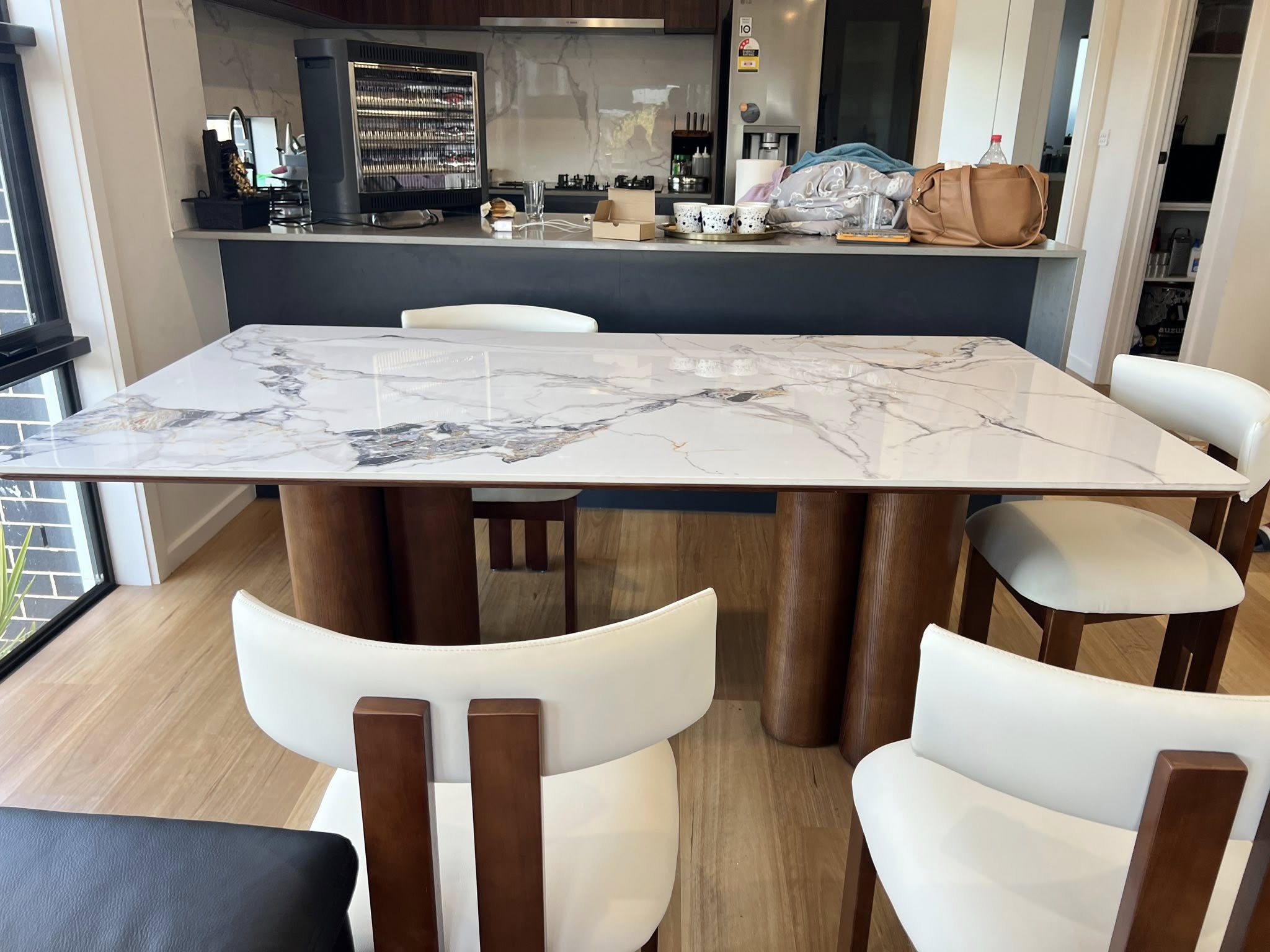
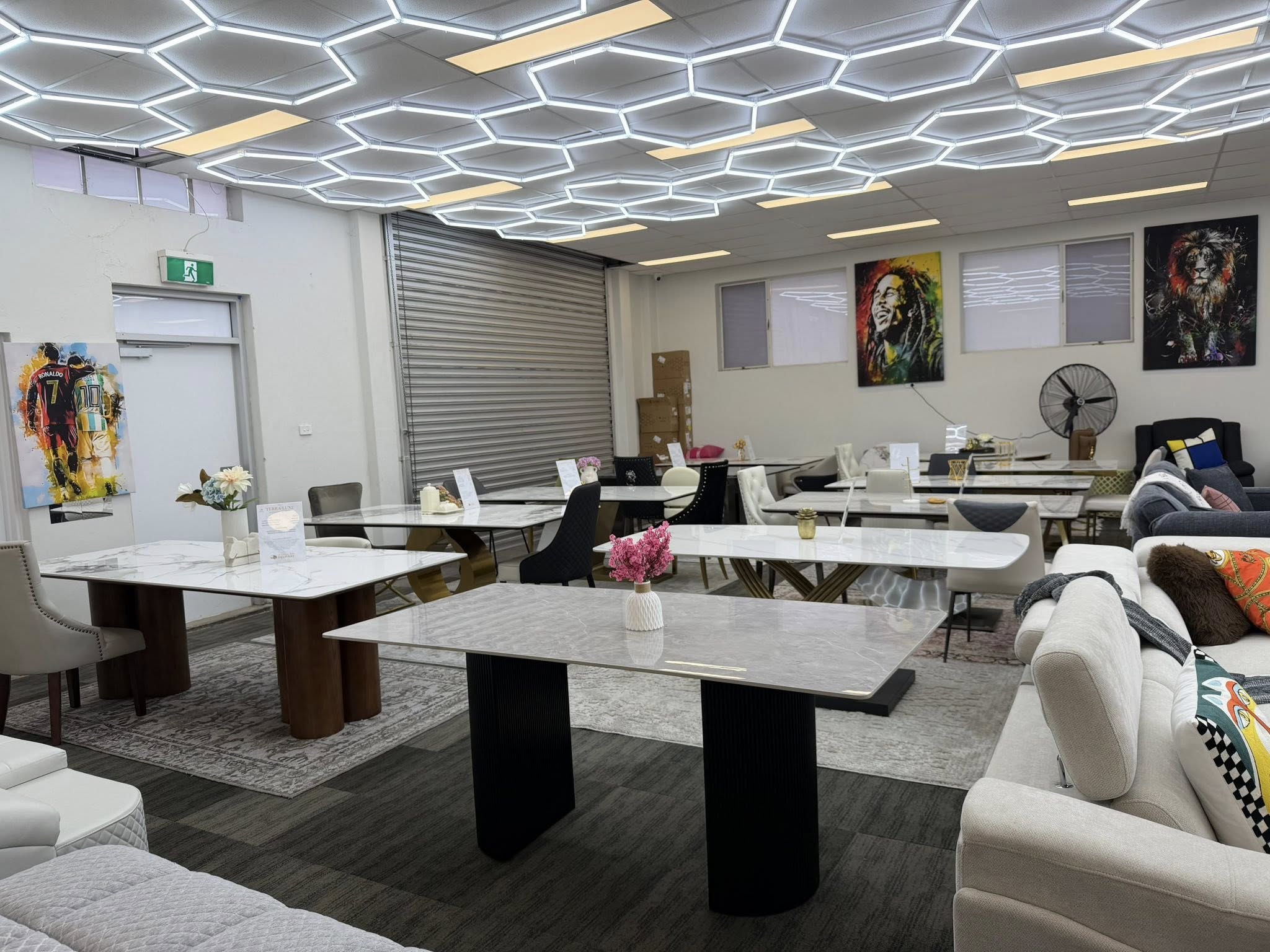


![Axel Springer Tower [de], Berlin](https://www.wikipedia.org/wiki/File%3A12-03-01-axel-springer-by-RalfR-28.jpg)


